








What's Happening?
The Cedars-Sinai Board of Governors Regenerative Medicine Institute, along with the Cedars-Sinai Biomanufacturing Center, is set to present groundbreaking research at the International Society for Stem Cell Research (ISSCR) 2026 meeting in Montreal. The focus
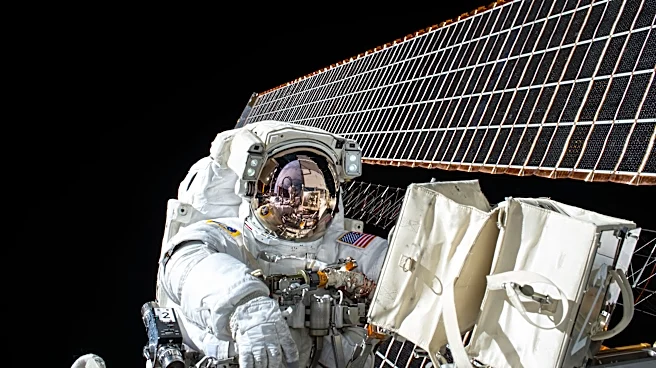
is on biomanufacturing in space, particularly how microgravity environments like those on the International Space Station can enhance the production of biomedical products. Researchers are exploring the potential of space-based manufacturing to produce higher-quality stem cells, organoids, engineered tissues, and biopharmaceuticals. The initiative involves collaboration with NASA, commercial space companies, and biotechnology partners, aiming to translate space-based discoveries into scalable manufacturing methods for regenerative medicine and personalized healthcare on Earth.
Why It's Important?
This research is significant as it could revolutionize the field of regenerative medicine by leveraging the unique conditions of space to improve the quality and consistency of biomedical products. The potential to produce superior stem cells and organoids in microgravity could lead to more effective therapies for a range of diseases. This advancement could also accelerate drug development and enhance personalized healthcare, offering new treatment options and improving patient outcomes. The collaboration with NASA and other space entities underscores the growing intersection between space exploration and medical innovation, potentially opening new frontiers in healthcare.
What's Next?
At the ISSCR 2026 meeting, key figures like Arun Sharma, PhD, and Avinash Srivastava, PhD, will discuss the implications of their research and the future of regenerative medicine in low Earth orbit. The focus will be on accelerating the development of organoid-based disease modeling and stem cell therapies. The Cedars-Sinai team will continue to refine their biomanufacturing processes, aiming to integrate these advancements into clinical and research applications on Earth. The ongoing collaboration with space agencies and biotech firms suggests a sustained effort to harness space environments for medical breakthroughs.