
What's Happening?
Researchers at Southeast University of Nanjing have developed a textile coating that significantly reduces the need for detergent in laundry, potentially transforming a common household activity with substantial
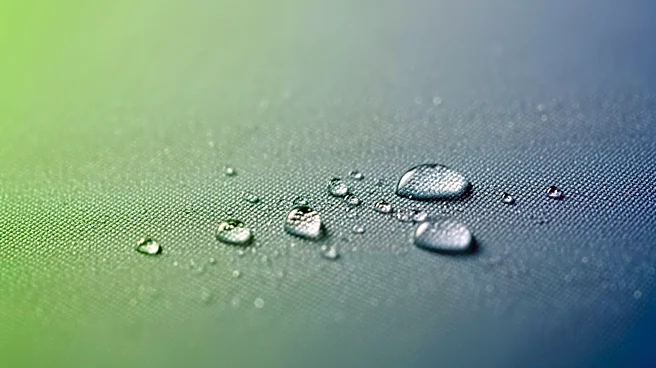
environmental impact. The innovation involves a polymer-based coating applied to fabrics, creating a surface that prevents dirt from adhering. This coating also forms a hydration layer that acts as a barrier against stains, functioning effectively under various light conditions. Tests have shown its effectiveness on materials like cotton, silk, and polyester, indicating its versatility. The new system simplifies the washing process by eliminating the need for detergent and reducing washing to a simple rinse, thereby decreasing water, energy, and time usage by 82%. The coating is also highly resistant, maintaining its effectiveness after multiple uses.
Why It's Important?
The development of this self-cleaning fabric has significant environmental and economic implications. By reducing the use of detergents, it addresses the issue of chemical pollution in water bodies, which affects aquatic biodiversity. The innovation also contributes to reducing the release of microplastics, thus protecting ocean health and preserving biodiversity. Economically, households could benefit from reduced operational costs due to savings in water and energy consumption. This innovation aligns with global efforts to mitigate climate change by lowering the domestic environmental footprint. The potential for long-term economic benefits and environmental protection makes this development a noteworthy advancement in sustainable living.
What's Next?
Despite its advantages, the self-cleaning fabric faces challenges such as limited effectiveness against solid particles and the need for comprehensive life cycle studies to evaluate its total impact. The initial cost of the coating may also be a barrier to widespread adoption, although it could be offset over time. The next step for this innovation is industrial scaling, which could expand its application to sectors like medical textiles. This development represents a significant shift towards more sustainable models in everyday habits, demonstrating the potential for innovation to drive environmental and economic benefits.