





What's Happening?
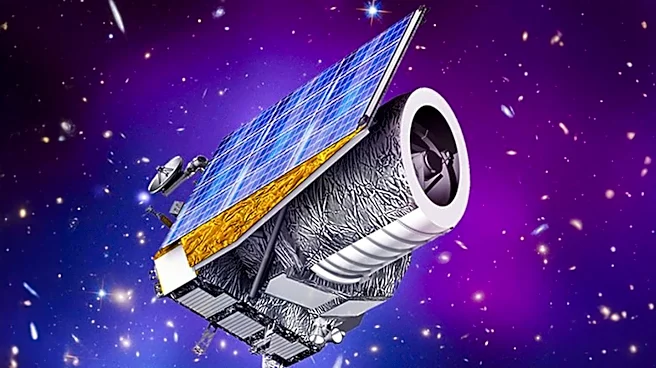
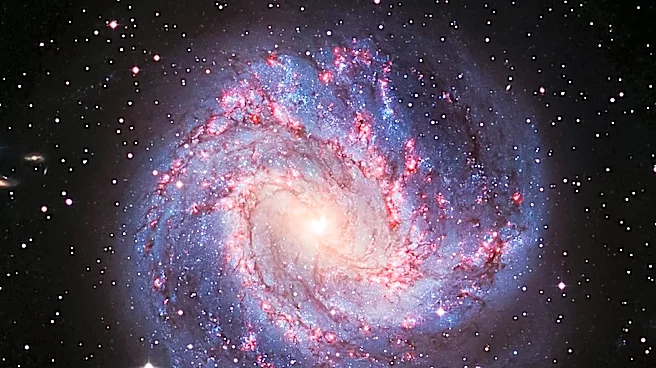
The European Space Agency's Euclid telescope has identified 31 of the oldest known quasars, significantly increasing the number of these ancient cosmic objects. Quasars are the luminous centers of early galaxies, powered by massive black holes. This discovery,
announced on July 6, 2026, and published in Astronomy & Astrophysics, marks a major advancement in understanding the early universe. The quasars were found at redshifts between 6.6 and 7.8, indicating they existed when the universe was less than a billion years old. Two of these quasars, with redshifts of 7.77 and 7.69, are the most ancient ever observed, shining with the brightness of a trillion suns. This discovery was made possible by Euclid's ability to efficiently survey large areas of the sky, capturing faint light from these distant objects.
Why It's Important?
This discovery is crucial for astrophysics as it provides insights into the early universe and the formation of galaxies. The quasars' existence challenges current understanding of black hole formation, as they appear fully formed in a relatively short cosmic timeframe. The findings suggest that these black holes, each with a mass of about a billion suns, grew rapidly in the universe's infancy, posing questions about the processes that allowed such rapid growth. This research could lead to a deeper understanding of cosmic evolution and the conditions that led to the formation of the first galaxies.
What's Next?
Euclid's mission, primarily focused on mapping dark matter and dark energy, will continue to survey the sky over the next six years. Researchers anticipate discovering more ancient quasars, potentially older than those currently identified. These findings will likely prompt further studies into the mechanisms of black hole growth and the early universe's conditions. The ongoing research aims to resolve the mystery of how these massive black holes formed so quickly, which remains one of the greatest challenges in astrophysics.
Beyond the Headlines
The discovery of these ancient quasars not only advances scientific knowledge but also highlights the capabilities of modern telescopes like Euclid. The ability to detect such faint and distant objects demonstrates the potential for future astronomical discoveries. This research underscores the importance of international collaboration in space exploration and the continuous development of technology to explore the universe's most profound mysteries.