



What's Happening?
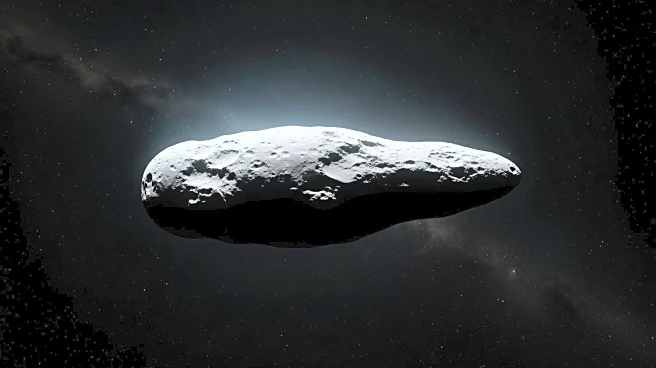
NASA's New Horizons spacecraft has provided new insights into the formation of Arrokoth, a peculiar peanut-shaped object located in the Kuiper Belt. This object, which consists of two distinct lobes, has intrigued scientists since its discovery. A recent
study published in the Monthly Notices of the Royal Astronomical Society suggests that Arrokoth and similar contact binaries could form directly through the gravitational collapse of small pebbles in the early solar system. This challenges previous theories that required external forces, such as gravitational interactions or gas drag, to bring the lobes together. The study, led by Jackson Barnes from Michigan State University, involved 54 numerical simulations, revealing that contact binaries could naturally form from collapsing clumps of small particles.
Why It's Important?
The findings from this study provide a new perspective on the formation of contact binaries in the Kuiper Belt, which could significantly impact our understanding of the early solar system. By demonstrating that these objects can form through simple gravitational collapse, the study challenges existing theories and suggests that such formations might be more common than previously thought. This could lead to a reevaluation of the processes that shaped the solar system's development. The research also highlights the potential for discovering more contact binaries, which could offer further insights into the conditions and materials present during the solar system's infancy.
What's Next?
Future research will likely focus on identifying more contact binaries in the Kuiper Belt to validate the study's findings. Astronomers may employ advanced observational techniques to overcome the challenges of inferring shapes from brightness patterns, especially given the distance of these objects. Additionally, further simulations and studies could explore the specific conditions under which gravitational collapse leads to the formation of contact binaries, potentially refining our understanding of the early solar system's dynamics.
Beyond the Headlines
The study's implications extend beyond the immediate findings, as it opens up new avenues for exploring the formation of other celestial bodies. Understanding the natural processes that lead to the creation of contact binaries could inform models of planet formation and the distribution of materials in the solar system. This research also underscores the importance of missions like New Horizons, which provide critical data that challenge and refine existing scientific theories.