

What's Happening?
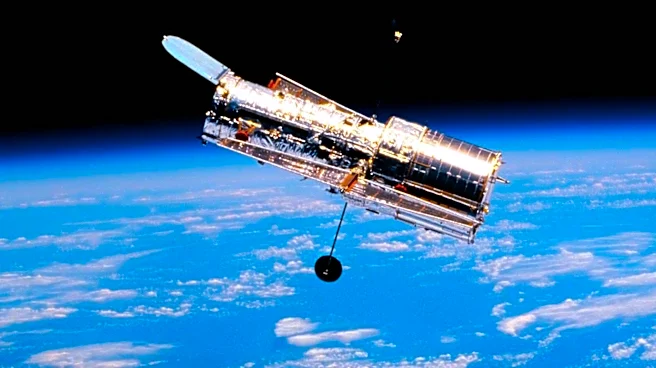
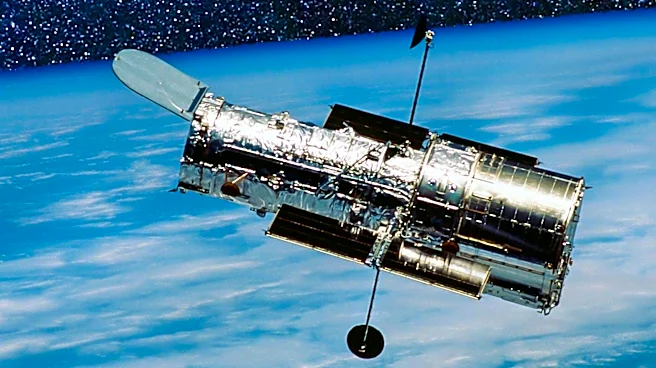
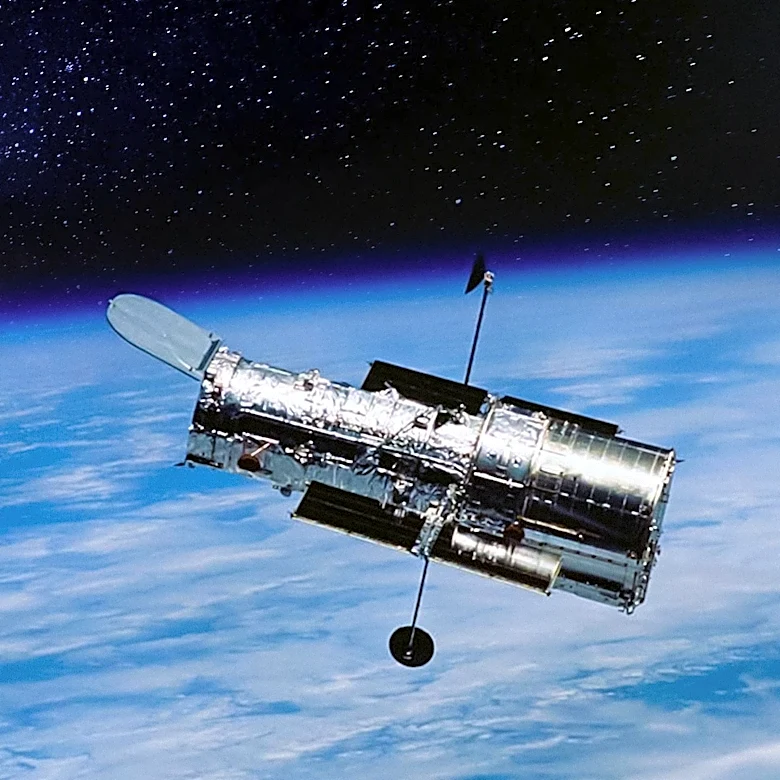
The Hubble Space Telescope has provided the strongest evidence to date for a globular cluster stellar stream located beyond the Milky Way galaxy. This discovery involves a narrow ribbon of stars observed next to the ultra-diffuse galaxy UGC 9050-Dw1,
situated approximately 115 million light-years away. Researchers, led by Julie Kiel Holm, described this feature, named Oyashio, in a peer-reviewed Nature paper. The stream appears to originate from a compact object, likely a globular cluster being torn apart by the host galaxy's tidal forces. The observation was independently confirmed using images from both the Hubble Space Telescope and the Canada-France-Hawaii Telescope. This finding is significant because streams created by disrupted globular clusters are much narrower than those from dwarf galaxies, providing a unique 'test particle' to study the gravitational fields of distant galaxies.
Why It's Important?
This discovery is crucial for advancing our understanding of dark matter distribution in distant galaxies. Stellar streams act as tracers of gravitational fields; their curves, widths, and density variations record the gravitational forces they encounter. By analyzing the Oyashio stream, scientists can infer the overall halo mass and inner density profile of the host galaxy, UGC 9050-Dw1. This method offers a new way to constrain the mass profiles of galaxies too distant for traditional star-by-star analysis. While Oyashio itself is not a direct image of dark matter, it provides a quantitative test of the unseen mass surrounding the galaxy. This breakthrough demonstrates that the method of using stellar streams to map gravity can be applied at extragalactic distances, opening new avenues for cosmological research and potentially refining models of galaxy formation and evolution.
What's Next?
Future observations and research will build upon this initial discovery. While the current study provides a compelling interpretation, deeper imaging and velocity measurements are needed to definitively confirm that the compact source and the stellar ribbon form a single dynamical system. The current model, which inferred a halo virial mass for UGC 9050-Dw1, still has wide uncertainties, indicating the need for more precise measurements and a larger sample of such streams. Upcoming telescopes like NASA’s Roman Space Telescope and Euclid are expected to play a significant role. These telescopes will offer wider fields of view than Hubble, increasing the chances of finding other faint, narrow structures around distant galaxies. A population of such streams, especially with measured velocities and longer visible arms, could provide even more robust tests of gravitational potentials and potentially reveal the presence of dark matter subhaloes through disturbances in the streams.
Beyond the Headlines
The identification of the Oyashio stream highlights the enduring value of existing astronomical data and the power of human observation combined with advanced modeling. The stream was initially noticed by David Hendel in previously published Hubble images, demonstrating that new scientific insights can emerge from re-examining old data with fresh perspectives. This echoes recent efforts using AI to search through vast archives of Hubble images, suggesting a future where both human intuition and artificial intelligence collaborate to uncover hidden structures in accumulated observations. Ethically, this discovery reinforces the importance of open access to scientific data, as it allows for independent verification and novel interpretations. Culturally, it expands our cosmic perspective, showing that the intricate processes of stellar disruption and dark matter influence are at play far beyond our immediate galactic neighborhood, continually revealing the universe's complex and dynamic nature.