
What's Happening?
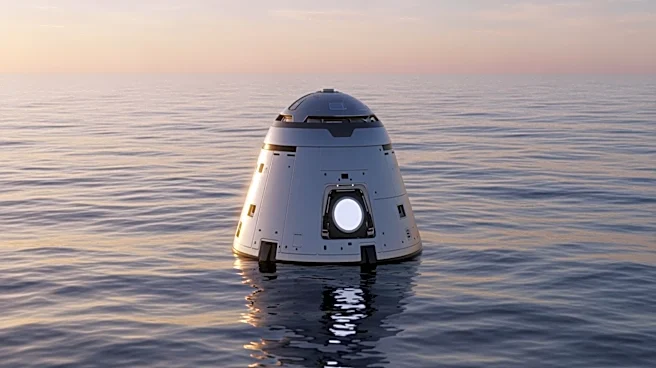
NASA's Artemis II mission has successfully concluded with the Orion spacecraft splashing down in the Pacific Ocean off the coast of San Diego, California. The mission, which lasted just over nine days,
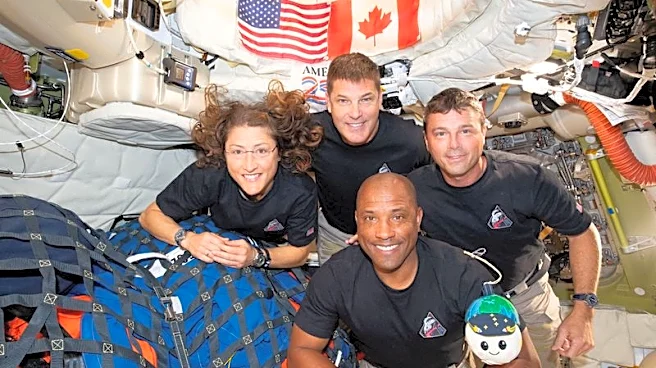
involved a crew of four astronauts—Commander Reid Wiseman, pilot Victor Glover, and mission specialists Christina Koch and Jeremy Hansen. The crew, which included three Americans and one Canadian, returned to Earth in good health, marking a significant milestone as the first mission to the Moon's orbit in over 50 years. During their journey, the astronauts traveled farther from Earth than any humans before, reaching approximately 252,760 miles. They orbited the Moon, capturing images of previously unseen lunar surfaces and witnessing a total solar eclipse. The mission was described as 'perfect' by NASA, with the crew being hailed as 'ambassadors to the stars.'
Why It's Important?
The successful completion of the Artemis II mission represents a pivotal moment for NASA and the future of space exploration. It signifies the United States' renewed commitment to lunar exploration and the broader goals of establishing a sustainable human presence on the Moon. This mission serves as a critical test of the Space Launch System (SLS) and Orion spacecraft, paving the way for future missions that aim to build a lunar base and prepare for potential human exploration of Mars. The mission's success also underscores the importance of international collaboration in space exploration, as evidenced by the inclusion of a Canadian astronaut in the crew. The advancements and data gathered from this mission will inform future endeavors and inspire continued investment in space technology and exploration.
What's Next?
Following the success of Artemis II, NASA is poised to advance its Artemis program with subsequent missions. The next steps involve planning for Artemis III, which aims to land astronauts on the lunar surface, potentially as early as the mid-2020s. This mission will focus on establishing a sustainable human presence on the Moon, including the construction of a lunar base. NASA's long-term vision includes using the Moon as a stepping stone for human exploration of Mars. The agency will continue to refine its technology and strategies, leveraging the insights gained from Artemis II to enhance safety and mission effectiveness. The success of Artemis II is expected to bolster public and governmental support for NASA's ambitious goals, potentially leading to increased funding and international partnerships.