



What's Happening?
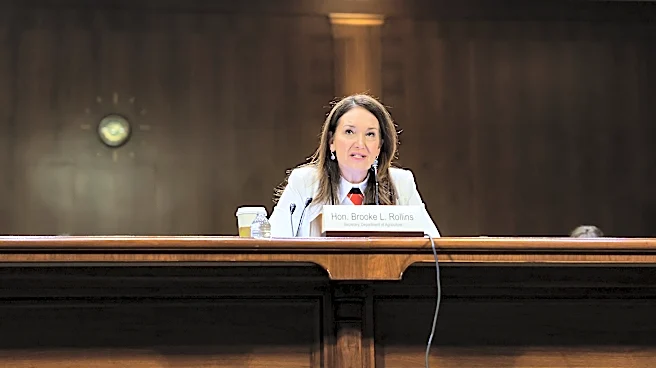
Agriculture Secretary Brooke Rollins has announced proposed changes to federal grazing rules, aiming to simplify permit requirements and standardize fees for ranchers utilizing national forests and grasslands. These proposed regulations would impact grazing permits,
eligibility criteria, and fee-setting mechanisms across 16 western states. The U.S. Department of Agriculture (USDA) indicates that these adjustments are designed to better align the regulations of the Forest Service and the Bureau of Land Management (BLM). This alignment is particularly beneficial for ranchers who operate on both types of federal land, as it would streamline administrative processes and create more consistent operational guidelines. The initiative seeks to address long-standing complexities in federal land management for agricultural purposes, potentially easing the burden on ranchers and promoting more uniform practices across different federal agencies.
Why It's Important?
These proposed changes are significant for the agricultural sector in the western United States, particularly for ranchers who rely on federal lands for grazing. By simplifying permit requirements and making fees more consistent, the USDA aims to reduce administrative hurdles and financial unpredictability for these operations. The alignment of Forest Service and BLM regulations is crucial because many ranchers manage livestock across land overseen by both agencies, often facing differing rules and procedures. This harmonization could lead to greater operational efficiency and cost savings for ranchers, potentially stabilizing their businesses in a region where federal land access is vital. The changes could also influence land management practices, promoting a more unified approach to grazing across vast federal territories and potentially impacting environmental conservation efforts and resource allocation in these areas.
What's Next?
The proposed rule will likely undergo a period of public comment, allowing stakeholders, including ranchers, environmental groups, and state agencies, to provide feedback. Following this period, the USDA will review the comments and may make further revisions before finalizing the rule. The implementation of these changes would then require ranchers and federal land managers to adapt to the new permit requirements and fee structures. There could be subsequent adjustments in how grazing permits are issued and managed, potentially leading to new guidelines for land use and conservation. The long-term impact will depend on how effectively the new rules are implemented and how they are received by the diverse groups with interests in federal land management.
Beyond the Headlines
Beyond the immediate operational benefits for ranchers, these proposed changes could signal a broader shift in federal land management policy, emphasizing efficiency and inter-agency coordination. The effort to align Forest Service and BLM regulations highlights a recognition of the need for a more cohesive approach to managing shared resources and users. This could set a precedent for future policy initiatives aimed at streamlining federal oversight across various sectors. Environmentally, while the stated goal is simplification, the long-term ecological impact of standardized grazing rules will be closely watched, particularly concerning biodiversity, soil health, and water resources in the affected western states. The balance between supporting agricultural livelihoods and preserving natural ecosystems remains a critical underlying tension in such policy decisions.