



What's Happening?
Mick Ryan's forthcoming novel, 'Pacific Storm,' is set to be published by Naval Institute Press in March 2027. This book is a sequel to his first novel, 'White Sun War,' and continues the narrative two years after a fictional failed invasion of Taiwan
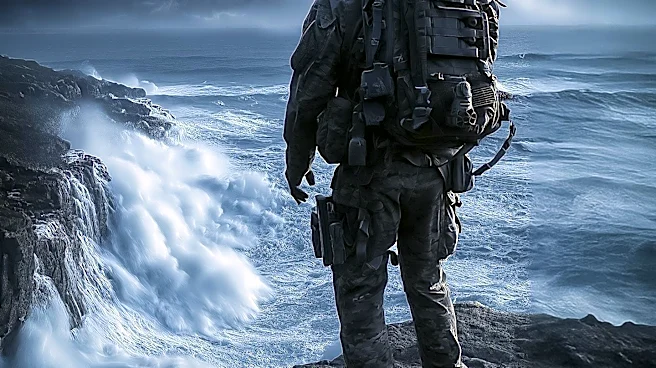
by China. 'Pacific Storm' depicts a wider conflict across the Pacific, where China, under new leadership, employs advanced tactics including autonomous weapons, space warfare, and strategic deception. The plot focuses on China's ambitious campaign to fracture allied unity, seize vital territory, and push American power back across the Pacific, rather than a direct assault on Taiwan. The story explores how soldiers, sailors, aviators, civilians, and political leaders adapt to prolonged, large-scale warfare across multiple domains, from remote islands to cislunar space and military headquarters in Washington and Beijing. Technology, including AI, space-based capabilities, uncrewed systems, and biological enhancement, plays a significant role.
Why It's Important?
The novel 'Pacific Storm' is important because it offers a fictional yet 'startlingly realistic portrait' of a potential future conflict in the Pacific, as described by M.P. Woodward. It serves as a 'strategic warning' and a 'catalyst for military and national security institutions to think about the character of modern war.' By exploring a scenario where China launches a wider war using advanced technologies and strategic deception, the book highlights potential vulnerabilities in allied unity and the challenges of prolonged, multi-domain warfare. The narrative emphasizes that success in such a conflict would depend not only on technology but also on leadership, courage, production capacity, and the ability to learn and adapt. This exploration of future conflict scenarios can inform strategic planning and preparedness within U.S. military and national security circles, prompting discussions on evolving strategies, leadership models, organizations, and technologies.
What's Next?
The novel 'Pacific Storm' is scheduled for publication in March 2027 by Naval Institute Press. Pre-orders are currently available through Naval Institute Press, Amazon, and other booksellers. Upon its release, the book is expected to generate discussions among military strategists, national security experts, and the general public interested in geopolitical fiction and future warfare. Its themes, which build on lessons from recent conflicts in Ukraine and the Middle East, are likely to resonate with those concerned about the evolving nature of modern warfare and the strategic competition in the Pacific. The author's hope is that the story will encourage military and national security institutions to consider new and evolved strategies and technologies.
Beyond the Headlines
Beyond its fictional narrative, 'Pacific Storm' delves into the deeper implications of technological advancements and geopolitical shifts on future conflicts. The emphasis on AI, robotics, space warfare, and strategic deception suggests a future where traditional military advantages may be challenged by asymmetric and technologically sophisticated approaches. The novel's focus on the human element—leadership, courage, and adaptability—amidst advanced technology underscores the enduring importance of human factors in warfare. It also implicitly raises ethical questions about the use of autonomous weapons and biological enhancements in conflict. The scenario of a fractured allied unity and a prolonged, large-scale war across half the globe highlights the potential for widespread societal impact, affecting civilians and political leaders alike. This fictional exploration serves as a thought experiment, prompting reflection on the societal and ethical dimensions of future conflicts.