
What's Happening?
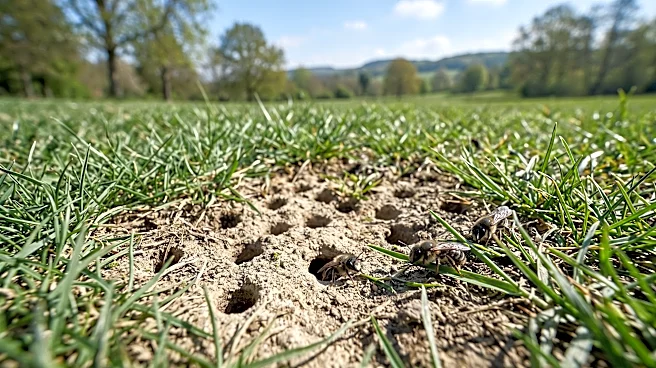
Scientists have discovered an estimated 5.5 million wild bees, specifically Andrena regularis (the regular mining bee), living in underground burrows beneath East Lawn Cemetery in Ithaca, New York. This
aggregation, spanning just 1.5 acres, is considered one of the largest nesting aggregations ever recorded for solitary insects. The discovery originated when a Cornell University entomology lab technician, Rachel Fordyce, noticed bees emerging from the turf in 2022. Researchers subsequently used emergence traps to estimate the population, finding between three and eight million bees, with 5.5 million as the midpoint. Unlike honeybees, mining bees are solitary, with each female digging her own burrow, stocking it with pollen and nectar, laying eggs, and sealing the entrance. The cemetery's sandy, well-drained soil, minimal pesticide use, diverse flora, and undisturbed ground have created an ideal habitat for these bees, which have likely been present for nearly a century, with specimens dating back to 1935. The findings were published in the journal Apidologie.
Why It's Important?
This discovery significantly alters scientific understanding of solitary insect colonies and their potential population densities. It highlights that vast, uncounted populations of native pollinators may exist in unexpected urban and suburban environments. New York is the second-largest apple-producing state, and earlier Cornell research indicated that native bees are two to three times more effective at pollinating apples than honeybees. The early emergence of mining bees, which overwinter as adults, coincides with apple tree blooms, suggesting these unmanaged bees have been providing substantial, unacknowledged pollination services to nearby orchards for decades. This underscores the critical role of native pollinators in agricultural ecosystems and the broader economy, particularly for crops reliant on insect pollination. The finding also emphasizes the need for conservation efforts in seemingly ordinary landscapes, as paving over such sites could lead to the rapid loss of millions of essential pollinators.
What's Next?
Senior author Bryan Danforth has initiated surveys of other cemeteries across New York State to identify similar large aggregations of ground-nesting bees. He has also launched a citizen science project on iNaturalist, encouraging the public to log observations of ground-nesting bees wherever they are found. Danforth anticipates that even larger aggregations may exist elsewhere. A critical concern moving forward is the vulnerability of these hidden populations; paving over such sites could lead to the rapid and unnoticed eradication of millions of pollinators. This highlights the need for increased awareness and potential protective measures for these crucial habitats, especially in urban and suburban areas where development pressures are constant. The research will likely inform future conservation strategies and land management practices to protect these vital, yet often overlooked, ecological assets.
Beyond the Headlines
The discovery of millions of wild bees in a cemetery challenges conventional perceptions of biodiversity and conservation. It reveals that significant ecological value can be found in human-modified landscapes, often 'hiding in plain sight.' This finding prompts a re-evaluation of urban planning and land use, suggesting that areas like cemeteries, parks, and even neglected lots could serve as crucial refuges for pollinator populations. Ethically, it raises questions about our responsibility to protect unseen ecological communities and the potential long-term consequences of development decisions made without full ecological understanding. Culturally, it could shift public perception of insects, moving beyond a focus on honeybees to appreciate the diverse and vital roles of solitary native bees. This discovery underscores the interconnectedness of urban environments with natural ecosystems and the profound impact human activities have, even inadvertently, on the survival of essential species.