





What's Happening?
In October, Mars will pass through the Beehive star cluster, also known as Messier 44 or M44, providing a notable astronomical event for stargazers. On October 5, Mars will first appear near a waning crescent moon. Less than a week later, from October 10
to October 12, Mars will move through the Beehive cluster. Specifically, it will be near the western edge on October 10, almost in the middle on October 11, and at the eastern edge on October 12. The Beehive cluster is one of the brightest open star clusters, located in the constellation Cancer the Crab. This cluster, visible with binoculars or a small telescope, contains about 100 stars and has been known by various names, including Praesepe, meaning 'the Manger,' for over 20 centuries. Galileo Galilei first resolved it into individual stars in 1610. The 'Beehive' moniker emerged later, inspired by the appearance of numerous stars resembling a swarm of bees through early telescopes. Mars, currently 152 million miles from Earth, has been gradually brightening in the morning sky and will continue to do so as it approaches Earth.
Why It's Important?
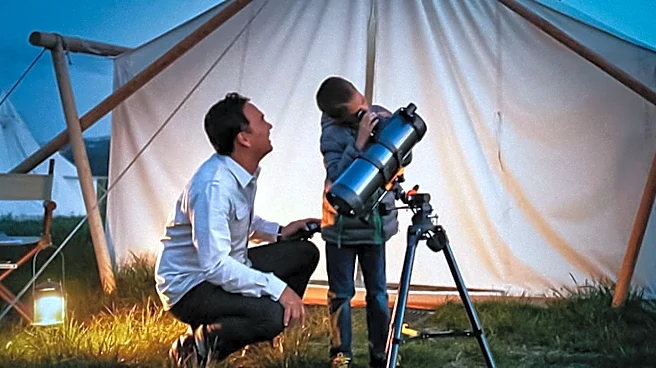
This celestial alignment offers a unique opportunity for both amateur and professional astronomers to observe Mars in a distinct context. The Beehive cluster, with its rich history and visibility, serves as an excellent backdrop for observing planetary motion. For the general public, it provides an accessible entry point into astronomy, encouraging engagement with the night sky using simple tools like binoculars. The event highlights the dynamic nature of our solar system and the broader universe, showcasing how planets move relative to distant star clusters. Historically, such alignments have been significant for understanding celestial mechanics and refining astronomical observations. The visibility of Mars, even as an amber-hued dot through most amateur telescopes, still contributes to public interest in space and science, potentially inspiring future generations of scientists and engineers. The event also underscores the enduring appeal of stargazing, connecting modern observers with ancient traditions of celestial observation.
What's Next?
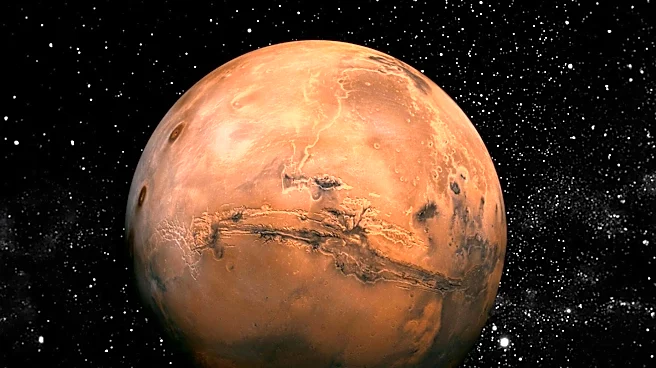
Following its transit through the Beehive cluster, Mars will continue its journey across the night sky. It will move towards the bluish first-magnitude star Regulus, crossing from the constellation Cancer into Leo the Lion by October 31. During this period, Mars is expected to brighten slightly, from magnitude +1.1 to +0.9, making it noticeably brighter than Regulus by the end of the month. A more significant event will occur on November 16, when Mars will pass just north of Jupiter. While telescopic observation of Mars in October will primarily show it as an amber dot, its brightness will increase as it continues to approach Earth. The closest approach of Mars to Earth will be on February 19, when it will be 63 million miles away, offering potentially better viewing opportunities for surface features through more powerful telescopes.
Beyond the Headlines
The observation of Mars passing through the Beehive cluster transcends a mere astronomical event; it connects contemporary stargazing with centuries of human curiosity about the cosmos. The dual naming of the cluster as 'Praesepe, the Manger' and 'Beehive' reflects different historical and cultural interpretations of the same celestial phenomenon, highlighting how human perception shapes our understanding of the universe. The fact that Galileo Galilei first resolved the cluster into individual stars in 1610 underscores the pivotal role of technological advancements, like the telescope, in expanding our cosmic perspective. This event also serves as a reminder of the accessibility of astronomy, as the Beehive cluster is visible with the naked eye from dark locations and easily observed with binoculars from urban areas. Such events foster a sense of wonder and encourage scientific literacy, demonstrating that profound astronomical observations do not always require advanced equipment but rather keen observation and an understanding of celestial mechanics.