
What's Happening?
Helen Czerski, a professor and oceanographer from University College London, delivered a lecture at the University of Hawai‘i at Mānoa as part of the Better Tomorrow Speaker Series. Her talk, titled 'The
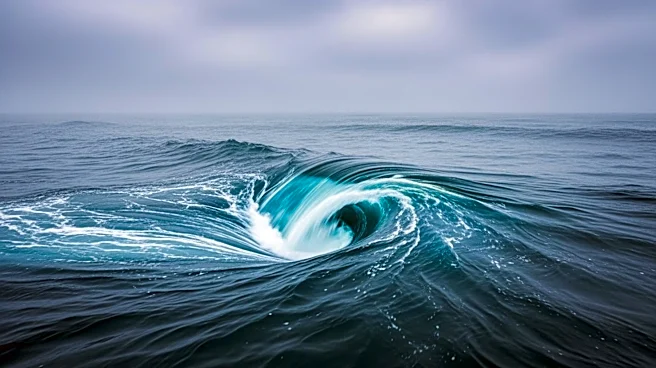
Blue Machine: How the Ocean Moves,' is based on her latest book and explores the ocean's role as a dynamic engine that powers the Earth. Czerski emphasizes that the ocean is not just a body of water but a complex system that moves heat, nutrients, and life around the globe. She describes the ocean as an engine that converts solar heat energy into movement, influencing global climate and ecosystems. Czerski's insights are informed by her academic research and her experiences in Hawai‘i, where she learned from local perspectives on the ocean's significance.
Why It's Important?
Czerski's lecture highlights the critical role of the ocean in regulating Earth's climate and supporting biodiversity. Understanding the ocean's dynamics is essential for addressing climate change and environmental challenges. The ocean's ability to distribute heat and nutrients affects weather patterns, marine life, and human societies. By framing the ocean as an engine, Czerski provides a compelling narrative that underscores the interconnectedness of natural systems. Her work encourages a multidisciplinary approach to oceanography, integrating scientific research with cultural insights. This perspective is vital for developing sustainable policies and practices that protect ocean health and mitigate climate impacts.
What's Next?
Czerski's lecture is part of a broader effort to raise awareness about the ocean's importance and inspire action to preserve marine environments. Future discussions and research may focus on specific oceanic processes and their implications for climate policy. Stakeholders, including scientists, policymakers, and the public, are encouraged to engage with these topics to foster a deeper understanding of the ocean's role in global systems. Continued collaboration between scientific and indigenous communities can enhance knowledge and inform effective conservation strategies.
Beyond the Headlines
Czerski's approach to oceanography highlights the value of diverse perspectives in understanding complex environmental issues. By incorporating indigenous knowledge and cultural viewpoints, her work challenges traditional scientific paradigms and promotes a more holistic understanding of the ocean. This inclusive approach can lead to more effective and culturally sensitive environmental policies. Additionally, Czerski's emphasis on storytelling as a tool for science communication can help bridge the gap between academia and the public, making scientific concepts more accessible and engaging.