




What's Happening?
MIT Sea Grant, in collaboration with underwater photographer Keith Ellenbogen, has documented the intricate spawning behaviors of longfin inshore squid (Doryteuthis pealeii) off the coast of Cape Cod, Massachusetts. This effort provides a rare glimpse
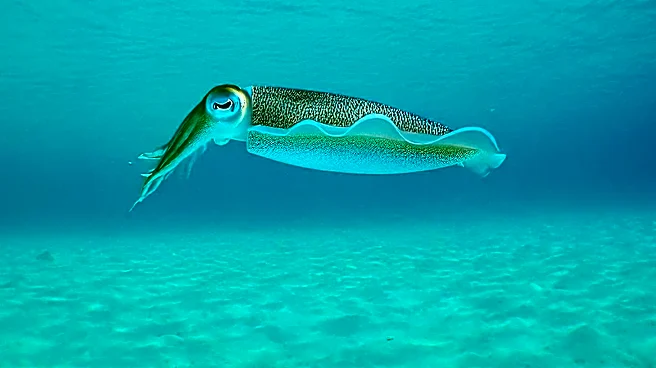
into the 'secret love life' of these cephalopods, which are a significant part of the region's commercial fisheries. Ellenbogen, after months of searching, captured images of large aggregations of squid engaged in courtship, competition, and egg-laying. The documentation reveals complex visual and chemical signaling, including rapid color changes and specific body postures, used by squid during spawning. Consort males, typically larger, guard females, while smaller 'sneaker males' attempt to fertilize eggs through stealth. Females deposit thousands of eggs in gelatinous capsules attached to the seafloor, often from multiple males.
Why It's Important?
The longfin squid is a crucial component of the Massachusetts seafood industry, consistently ranking among the top commercially landed species. Understanding their reproductive biology and behavior is vital for sustainable fisheries management, especially given their unpredictable population dynamics due to a short lifespan and sensitivity to ocean conditions. Recent data from 2024 showed a significant drop in longfin squid landings and biomass compared to a record high in 2023, highlighting the need for comprehensive research. This documentation by MIT Sea Grant and NOAA's Northeast Fisheries Science Center (NEFSC) contributes to ongoing efforts to improve squid science, including studies on their life history, maturity, and spawning readiness. Better knowledge of these processes can inform more effective conservation strategies and ensure the long-term viability of this economically important species.
What's Next?
Scientists, including those from NOAA's NEFSC, will continue to expand squid research, building on the insights gained from this documentation. Ongoing initiatives like the Longfin Squid Biological Sampling Program (SQUIBS) and Collaborative SQUid Size Monitoring (SQUISM) aim to gather more data on squid populations and their reproductive cycles. The interdisciplinary Squid-Squad, comprising scientists, industry members, and managers, will likely utilize these findings to refine management practices and improve the accuracy of population assessments. Further research will focus on deciphering the complex communication signals of squid, which remain largely a mystery, to better understand their social and reproductive interactions. The goal is to develop more robust models for predicting population fluctuations and ensuring the sustainability of the longfin squid fishery.
Beyond the Headlines
The documentation of longfin squid spawning highlights the broader challenges and complexities of marine ecosystem management. The inherent unpredictability of species with short lifespans and high sensitivity to environmental changes, like the longfin squid, underscores the need for adaptive and data-driven approaches to fisheries. This work also exemplifies the intersection of art and science, where visual documentation by underwater photographers like Keith Ellenbogen can provide invaluable scientific data and raise public awareness about marine biodiversity. The 'secret love life' of these squid, with their intricate courtship rituals and competitive spawning strategies, offers a fascinating case study in evolutionary biology and behavioral ecology, revealing the hidden wonders of the ocean that are often overlooked in commercial contexts. It also emphasizes the importance of collaborative efforts between research institutions, government agencies, and the fishing industry to achieve sustainable outcomes.