







What's Happening?
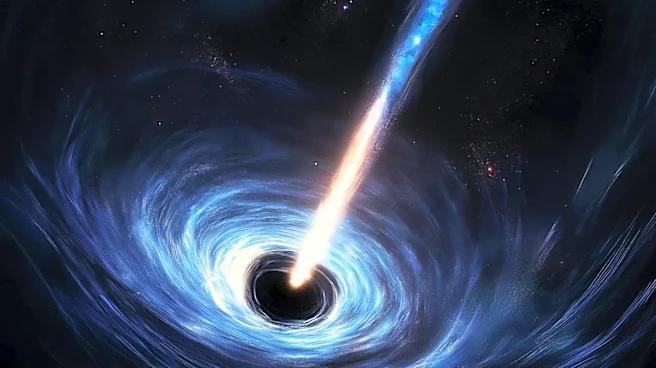
Researchers at the Advanced Science Research Center at the CUNY Graduate Center have successfully simulated a black hole energy extraction process in a laboratory setting. This experiment, based on a theory proposed by Sir Roger Penrose over 50 years
ago, involves using synthetic rotation to mimic the conditions around a rapidly spinning black hole. The team used a radio frequency device to create a pattern that imitates ultrafast rotation, allowing electromagnetic waves to extract energy from the system. This breakthrough provides a new platform for exploring extreme physics phenomena without the need for actual black holes.
Why It's Important?
This experimental achievement marks a significant advancement in the field of astrophysics and wave physics, as it brings theoretical concepts into practical experimentation. By simulating black hole conditions, scientists can explore extreme physical phenomena in a controlled environment, potentially leading to new insights in quantum science and wave behavior. The findings could have implications for future technologies in communications, optics, and photonics, as well as contribute to a deeper understanding of the universe's most extreme environments. This research underscores the potential for laboratory-based studies to advance theoretical physics and inspire technological innovation.