







What's Happening?
Astronomers have identified a potentially habitable exoplanet, GJ 3378b, located just 25 light-years from Earth. This super-Earth, orbiting a red dwarf star, has been found to be in the habitable zone where liquid water could exist on its surface. Initial
observations estimated its mass at 5.3 Earth masses, but recent studies have refined this to 2.3 Earth masses, increasing the likelihood of it being rocky. The planet's proximity to its star, with an orbital period of 21.45 days, places it in a position to receive about 90% of the radiation Earth receives from the Sun. However, the presence of an atmosphere, crucial for sustaining liquid water, remains unknown. The discovery, led by astronomer Paul Robertson from the University of California, Irvine, highlights GJ 3378b as one of the most Earth-like exoplanets within the 10-parsec solar neighborhood.
Why It's Important?
The discovery of GJ 3378b is significant as it adds to the list of potentially habitable exoplanets close to Earth, offering a prime target for future studies on habitability and the search for extraterrestrial life. The planet's characteristics, such as its mass and position in the habitable zone, make it a compelling candidate for further investigation. Understanding whether GJ 3378b has an atmosphere could provide insights into the conditions necessary for life beyond Earth. This discovery also underscores the importance of precision in astronomical measurements, as small changes in data can significantly alter our understanding of a planet's potential to support life. The research contributes to the broader quest to determine if Earth is unique in its ability to host life.
What's Next?
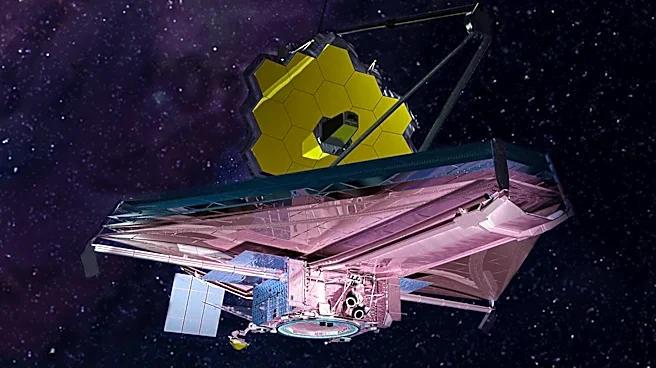
Future research will focus on determining whether GJ 3378b has an atmosphere, which is essential for sustaining liquid water and, by extension, life. This will involve using advanced telescopes and instruments capable of detecting atmospheric signatures. The planet's proximity to Earth makes it an ideal candidate for such studies, as it is easier to observe than more distant exoplanets. Additionally, understanding the activity of its host star, a red dwarf known for frequent flares, will be crucial in assessing the planet's habitability. The ultimate goal is to identify biosignatures that could indicate the presence of life, bringing us closer to answering the question of whether we are alone in the universe.