

What's Happening?
NASA's Artemis II mission is gearing up for a significant milestone in space exploration, with a planned crewed flyby around the Moon set for April 2026. The mission will involve a crew of four astronauts, including Commander Reid Wiseman, Pilot Victor
Glover, Mission Specialist Christina Koch, and Canadian Space Agency's Jeremy Hansen. The mission aims to test life support systems, radiation protection, and deep-space operational capabilities, which are crucial for future Mars missions. The European Space Agency is contributing the Service Module, and Canada is providing an astronaut, highlighting international collaboration.
Why It's Important?
Artemis II represents a critical step in NASA's long-term goal of establishing a sustainable human presence on the Moon and eventually sending humans to Mars. The mission will provide valuable data on human survival in deep space, including radiation exposure and life support system performance. This information is essential for planning longer missions to Mars, where astronauts will face similar challenges. The mission also underscores the importance of international partnerships in advancing space exploration, as it involves contributions from multiple countries.
What's Next?
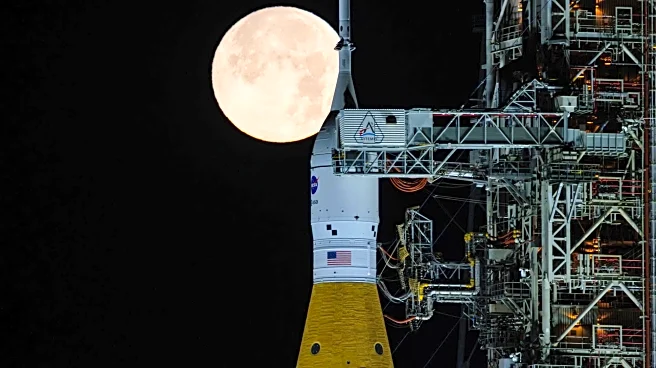
As the launch date approaches, NASA will continue final preparations at the Kennedy Space Center. The mission's success will pave the way for Artemis III, which aims to land astronauts on the Moon. The data collected from Artemis II will inform the design of future missions, including those targeting Mars. The mission's progress will be closely watched by the global space community, as it represents a significant advancement in human space exploration capabilities.