


What's Happening?
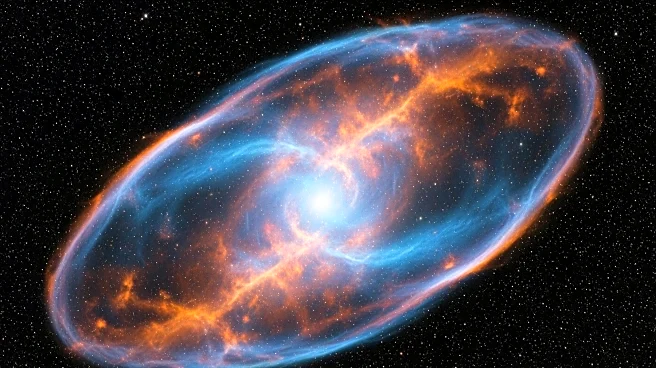
NASA's Hubble Space Telescope has captured a remarkable image of the Egg Nebula, located about 1,000 light years away in the constellation Cygnus. The nebula, a pre-planetary nebula, is characterized by its unique structure of dust and gas expelled by a dying
star. The image reveals intricate details, including two bright beams streaming from the hidden central star, illuminating fast-moving polar lobes. This nebula offers astronomers a rare opportunity to study the early stages of stellar evolution, as it is the first, youngest, and closest pre-planetary nebula identified.
Why It's Important?
The Egg Nebula provides valuable insights into the processes that occur as Sun-like stars approach the end of their life cycles. Understanding these early stages of stellar evolution can help scientists learn more about the formation of planetary nebulae and the recycling of stellar material. This knowledge is crucial for comprehending the life cycle of stars and the creation of new star systems, including those that may eventually form planets. The detailed observations made by the Hubble Space Telescope continue to enhance our understanding of the universe and the complex processes that shape it.
What's Next?
Continued observations of the Egg Nebula by the Hubble Space Telescope and other instruments will likely provide further insights into the dynamics of pre-planetary nebulae. Scientists will analyze the data to better understand the mechanisms driving the ejection of material and the formation of symmetrical structures. These studies may also explore the potential influence of unseen companion stars on the nebula's development. As technology advances, future telescopes may offer even more detailed views, allowing astronomers to refine their models of stellar evolution and the lifecycle of stars.