






What's Happening?
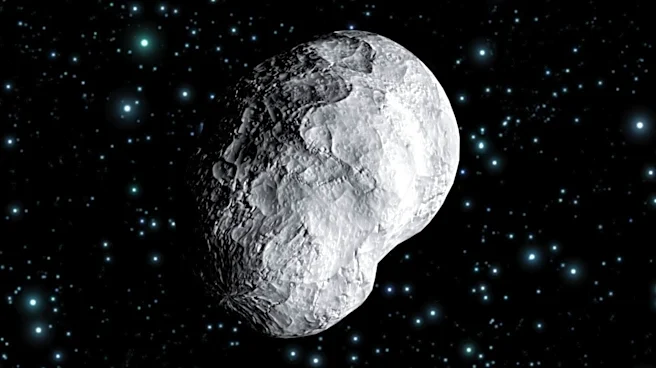
A recent study published in 2026 has examined a meteorite known as Northwest Africa 12774, suggesting it may contain material from a vanished planetary embryo that once orbited the young Sun. This meteorite, classified as an angrite, was found in Northwest Africa and
is believed to preserve evidence of a body potentially comparable in size to the Moon. The study, published in Earth and Planetary Science Letters, identifies high-pressure clinopyroxene within the meteorite, indicating formation under significant pressure. Researchers argue that this points to a parent body much larger than previously assumed for angrites, which were thought to originate from small asteroids. The findings suggest that the early solar system may have contained many such planetary embryos, some of which were large enough to develop geological histories before being destroyed or incorporated into other celestial bodies.
Why It's Important?
The study's implications extend beyond the discovery of a potential lost world. It challenges existing assumptions about the early solar system's composition and the origins of meteorites. If the findings are accurate, they suggest that some meteorites may be remnants of larger, geologically active bodies rather than mere asteroid fragments. This could reshape our understanding of planetary formation and the processes that shaped the inner solar system. The research highlights the complexity of early solar system dynamics, where many planetary embryos existed, some merging to form planets like Earth, while others were destroyed. This discovery could lead to a reevaluation of meteorite collections, as similar evidence of large parent bodies might be found in other samples.
What's Next?
Future research will likely focus on further analyzing meteorites to identify other potential remnants of large planetary embryos. Advances in imaging, microanalysis, and geobarometry could uncover more evidence of such bodies, providing deeper insights into the early solar system's history. Additionally, the study may prompt a reexamination of existing meteorite collections, as modern techniques could reveal new information about their origins. The scientific community may also explore the implications of these findings for understanding planetary formation processes and the evolution of the solar system.
Beyond the Headlines
The study raises questions about the completeness of our current understanding of the solar system's history. It suggests that the list of known planets is not representative of the early solar system's full population. The findings emphasize the dynamic and transient nature of planetary formation, where many bodies existed only temporarily. This perspective could influence future planetary science research, encouraging scientists to consider the possibility of other lost worlds and the role they played in shaping the solar system as we know it today.