





What's Happening?
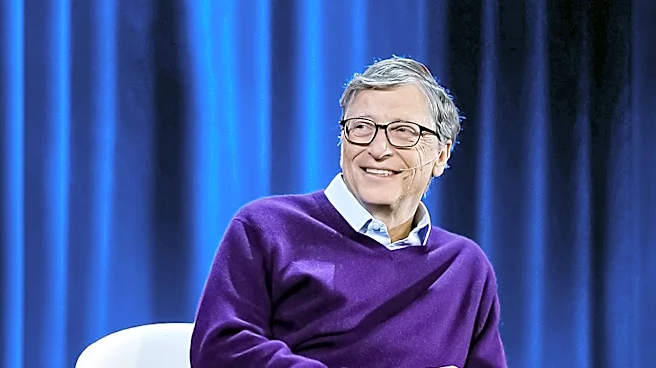
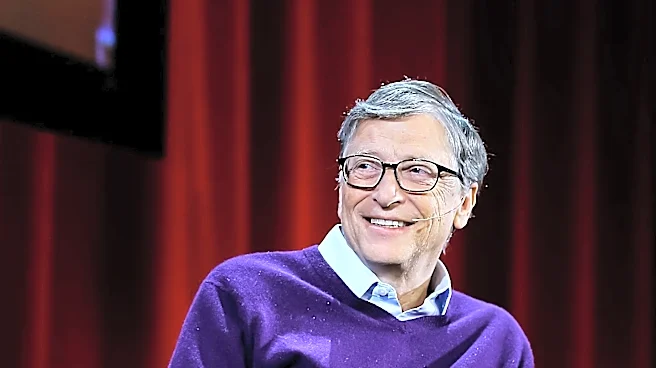
During an interview with Ezra Klein, Bill Gates articulated profound concerns regarding the safety and potential dangers of artificial intelligence, stating that AI poses a greater threat than nuclear weapons. Gates emphasized that current AI systems
could be used to create bioweapons, a risk he considers tangible, immediate, and profound. He questioned the sufficiency of product liability and existing safeguards, arguing that open-source AI models capable of creating bioweapons can bypass monitoring. Gates highlighted a perceived lack of societal response and engagement outside the tech industry, despite what he views as the crossing of critical dangerous thresholds in AI development. This perspective contrasts sharply with that of technologists like Jensen Huang, who, in his own interview with Klein, dismissed 'AI alarmism' and argued against new regulations, advocating for rapid advancement.
Why It's Important?
Bill Gates's stark warning about AI's potential for harm, particularly its comparison to nuclear weapons, underscores a critical debate within the U.S. and global technology landscape. His concerns highlight the urgent need for robust regulatory frameworks and societal engagement to manage the risks associated with rapidly advancing AI. The divergence in opinions between figures like Gates and Huang reflects a fundamental disagreement on the balance between innovation and safety, which could significantly influence future policy decisions, research funding, and ethical guidelines for AI development. If Gates's warnings are heeded, it could lead to increased government oversight, stricter development protocols, and a re-evaluation of the open-source AI movement, potentially impacting the pace of technological progress and the competitive landscape among AI developers. Conversely, a lack of action could expose society to unprecedented risks, including the misuse of AI for malicious purposes like bioweapon creation, with potentially catastrophic consequences for national security and public health.
What's Next?
The ongoing debate between prominent figures like Bill Gates and Jensen Huang is likely to intensify calls for legislative action and international cooperation on AI governance. Policymakers in the U.S. may face increasing pressure to develop comprehensive regulations that address AI safety, liability, and ethical implications. This could involve establishing new federal agencies or expanding the mandates of existing ones, similar to the FDA or airline safety boards, to oversee AI development and deployment. The tech industry itself may see internal shifts, with some companies potentially adopting more cautious development practices or investing more heavily in safety research. Public discourse is also expected to evolve, potentially leading to greater public awareness and demand for accountability from AI developers. The outcome of these discussions will shape the future trajectory of AI, influencing everything from research priorities to the commercialization of new AI technologies and their integration into daily life.
Beyond the Headlines
The profound concerns raised by Bill Gates extend beyond immediate technological risks, touching upon deep philosophical and societal questions. His vision of a future where AI could eliminate shortages and diseases, yet simultaneously challenge human purpose and societal structures, highlights the transformative potential and inherent dilemmas of advanced AI. The comparison of AI's arrival to an 'evolutionary history' or the appearance of 'aliens created in laboratories' suggests a paradigm shift that could fundamentally alter human existence. This raises ethical considerations about human control over increasingly autonomous systems, the distribution of power in an AI-driven world, and the very definition of human flourishing. The tension between rapid technological advancement and the need for societal control, as articulated by Gates, points to a long-term challenge of ensuring that AI serves humanity's best interests rather than becoming an existential threat. The lack of widespread public reaction to such grave warnings, as noted in the source, also suggests a potential societal unpreparedness for the scale of change AI might bring.