





What's Happening?
NASA's Artemis II mission has successfully concluded a nine-day crewed flight test of the Orion spacecraft, marking the first human journey beyond Earth's orbit in over 50 years. The mission, which launched on April 1, 2026, involved astronauts Reid Wiseman,
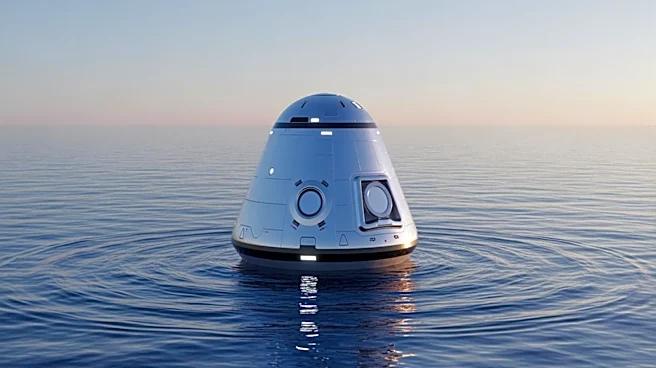
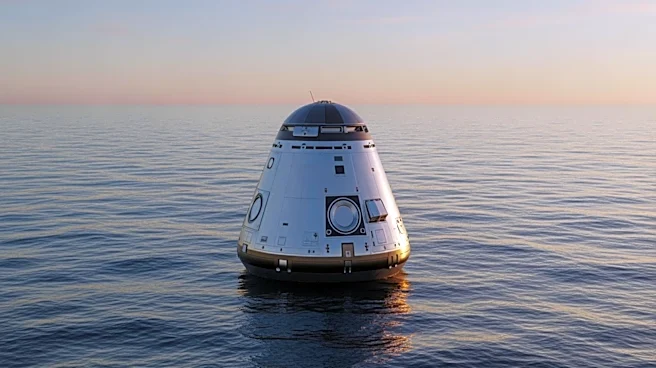
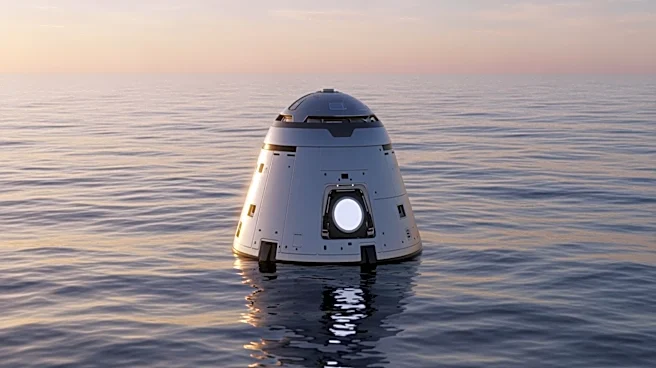
Victor Glover, Christina Koch, and Canadian Jeremy Hansen. The crew conducted a series of tests on the spacecraft's systems, including life support, propulsion, and re-entry capabilities. The mission also set a new distance record for human spaceflight, traveling as far as 252,756 miles from Earth. The Orion capsule, named Integrity, re-entered Earth's atmosphere and splashed down in the Pacific Ocean southeast of San Diego on April 10, 2026. This mission is part of NASA's broader Artemis program, which aims to establish a sustainable human presence on the Moon by the end of the decade.
Why It's Important?
The successful completion of Artemis II is a significant milestone in NASA's efforts to return humans to the Moon and eventually establish a lunar base. This mission tested critical systems that will be used in future lunar landings, including manual piloting and docking procedures. The data collected will inform the design and operation of future missions, ensuring the safety and effectiveness of human space exploration. The mission also demonstrated international collaboration, with Canadian astronaut Jeremy Hansen participating, highlighting the global nature of space exploration. The Artemis program is expected to drive technological advancements and inspire a new generation of scientists and engineers.
What's Next?
Following the success of Artemis II, NASA is preparing for Artemis III, which will test the Orion spacecraft's ability to rendezvous and dock with a Human Landing System in Earth orbit. This mission is scheduled for next year and will address technical issues identified during Artemis II, such as a helium leak in the propulsion system and a malfunctioning urine vent line. NASA is also working with SpaceX and Blue Origin to develop the Human Landing Systems needed for lunar surface operations. The ultimate goal is to establish a sustainable human presence on the Moon by 2029, paving the way for future missions to Mars.
Beyond the Headlines
The Artemis II mission not only advances NASA's lunar exploration goals but also has broader implications for international cooperation in space. The involvement of the Canadian Space Agency and the European Space Agency in the mission underscores the collaborative nature of modern space exploration. Additionally, the mission's success could stimulate interest and investment in space technologies, potentially leading to new commercial opportunities. The mission also serves as a reminder of the importance of addressing technical challenges in space exploration, as seen with the issues encountered with the Orion spacecraft's systems.