
What's Happening?
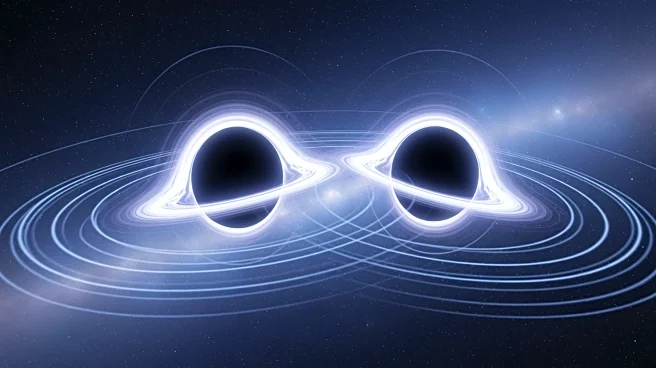
The LIGO-Virgo-KAGRA collaboration has captured a detailed observation of a black hole merger, providing new insights into black hole behavior. The event, known as GW250114, was observed with improved
detector sensitivity, allowing researchers to verify predictions about black holes. The study confirmed that black holes formed through mergers do not decrease in size, supporting Stephen Hawking's theory. Additionally, the research showed that disturbed black holes vibrate like a ringing bell, consistent with Albert Einstein's general theory of relativity. These findings enhance the understanding of black hole dynamics and gravitational waves.
Why It's Important?
This research is crucial for advancing the understanding of black holes and gravitational waves, which are fundamental to the study of the universe. By confirming theoretical predictions, the study strengthens the scientific foundation for black hole physics and supports existing models of the universe's structure. The ability to observe black hole mergers with high precision opens new avenues for exploring the nature of gravity and spacetime. These insights could lead to further discoveries about the universe's most extreme environments and the fundamental laws governing them.
What's Next?
The collaboration plans to continue improving gravitational wave detectors, such as LIGO, to gain even clearer observations of black holes and their interactions. Future research will focus on exploring the implications of these findings for cosmology and fundamental physics. As detector technology advances, scientists anticipate uncovering more about the mysteries of black holes and their role in the universe. The ongoing study of gravitational waves will likely lead to new discoveries and a deeper understanding of the cosmos.