
What's Happening?
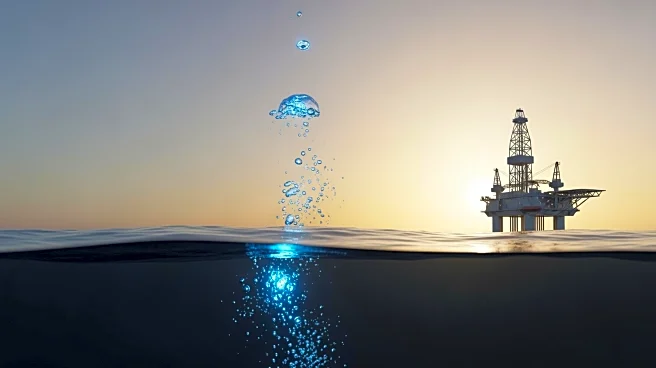
Philippine President Ferdinand Marcos Jr. has announced the discovery of a new natural gas deposit near the existing Malampaya gas field in waters facing the disputed South China Sea. This new reservoir,
named Malampaya East 1, is located about 5 kilometers east of the main Malampaya field. The discovery is significant as it could supply power to more than 5.7 million households annually. The undersea reservoir is estimated to contain approximately 98 billion cubic feet of gas, with initial tests indicating that 60 million cubic feet could be extracted daily. This discovery is crucial as the Malampaya gas field, which has been operational for over two decades, was projected to decline significantly in the coming years. The Malampaya facility currently provides over 20% of the electricity to Luzon, the most populous region in the Philippines.
Why It's Important?
The discovery of the Malampaya East 1 gas deposit is a critical development for the Philippines, potentially averting a looming power crisis in Luzon, where the capital and main financial district are located. As the existing Malampaya field was nearing depletion, this new find could ensure a continued supply of natural gas, which is vital for the country's energy security. The discovery also strengthens the Philippines' domestic gas supply, reducing reliance on imported energy sources. Additionally, the presence of condensate, a high-value liquid fuel, in the new deposit could provide further economic benefits. However, the geopolitical implications are significant, as the area is within the Philippines' Exclusive Economic Zone but also part of the disputed South China Sea, where China has asserted extensive territorial claims.
What's Next?
The next steps involve determining the timeline for commercial production from the Malampaya East 1 deposit. The Philippine government and the consortium involved in the discovery will likely focus on developing the necessary infrastructure to begin extraction. Additionally, the geopolitical tensions in the South China Sea may influence future developments, as the area is contested by multiple countries, including China. The Philippines may need to navigate diplomatic challenges to ensure the security and viability of its energy resources in the region.
Beyond the Headlines
The discovery of Malampaya East 1 highlights the ongoing geopolitical tensions in the South China Sea, where multiple countries, including China, Vietnam, and Malaysia, have overlapping territorial claims. The Philippines' ability to exploit this new resource could set a precedent for other nations in the region, potentially leading to increased exploration and development activities. However, it also raises questions about the enforcement of international maritime laws and the role of regional cooperation in managing shared resources. The situation underscores the importance of diplomatic engagement and conflict resolution mechanisms to address the complex territorial disputes in the South China Sea.