








What's Happening?
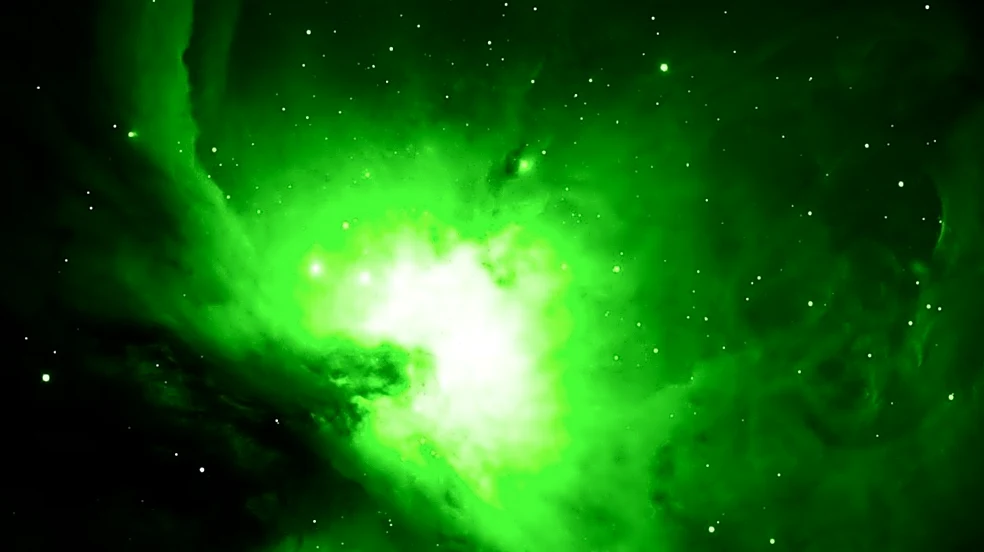
Astronomers have announced the discovery of the first white dwarf 'zombie' star, designated WD J1330+6435, which exhibits a 'ghostly green glow.' This unusual coloration is attributed to the star consuming rocky debris from dead planets. Astrophysicist
Mark Hollands, whose team from the University of Warwick made the finding, explained that traces of sodium in the white dwarf's atmosphere absorb the orange part of the light spectrum, leaving behind the green hue. White dwarfs are the dense remnants of stars that have exhausted their nuclear fuel and shed their outer layers. In this 'zombie' phase, they continue to 'live' by gravitationally devouring planets, asteroids, and other celestial bodies. The discovery marks the first time researchers have observed a green star and confirmed that the color of these super-dense stars can be altered by the elements they absorb, such as carbon, calcium, and sodium. The star is located in the Milky Way, approximately 280 light-years from our solar system, and can be faintly seen in the constellation Draco.
Why It's Important?
This discovery significantly advances our understanding of stellar evolution and the chemical composition of white dwarf stars. Previously, the color of most stars, including white dwarfs, was primarily understood to be determined by their temperature. The finding that absorbed elements can dramatically alter a white dwarf's color introduces a new dimension to stellar classification and analysis. This provides astronomers with a novel method to infer the past dietary habits of these 'zombie' stars, offering insights into the composition of the planetary systems they once hosted. It also opens new avenues for studying the remnants of exoplanets and the processes of planetary destruction and accretion around dying stars. Understanding these processes can shed light on the ultimate fate of planetary systems, including our own, as Earth's sun is expected to become a white dwarf in about 5 billion years.
What's Next?
Researchers will likely continue to search for other unusually colored white dwarfs to further validate and expand upon these findings. The methodology used to identify WD J1330+6435, focusing on spectral analysis to detect elemental absorption, will be refined and applied to a broader sample of white dwarfs. This could lead to the discovery of stars with other unexpected colors, providing a more comprehensive understanding of the diverse chemical interactions occurring in these stellar remnants. Future studies may also involve more detailed spectroscopic analysis to precisely quantify the elemental composition of these stars and model the processes by which they accrete and incorporate planetary material. This research will contribute to a more nuanced picture of the late stages of stellar and planetary system evolution.
Beyond the Headlines
The concept of a 'zombie' star with a 'ghostly green glow' evokes a sense of the extraordinary and the unexpected in the cosmos, challenging conventional perceptions of stellar appearance. This discovery has broader implications for astrobiology and the search for life, as it provides clues about the chemical makeup of exoplanetary debris. The elements found in the star's atmosphere, such as calcium, lithium, and sodium, are fundamental building blocks of planets. Understanding how these elements are incorporated into white dwarfs can offer insights into the prevalence and diversity of planetary compositions across the galaxy. Furthermore, the idea that our own sun will eventually become a white dwarf that consumes its inner planets adds a profound, long-term perspective to humanity's place in the universe, highlighting the cyclical nature of cosmic existence and the eventual demise and recycling of stellar and planetary matter.