





What's Happening?
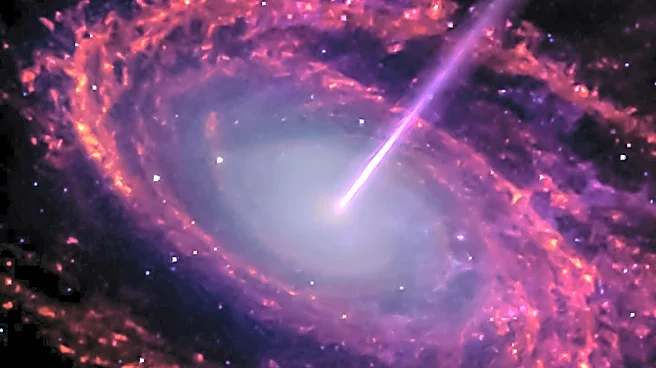
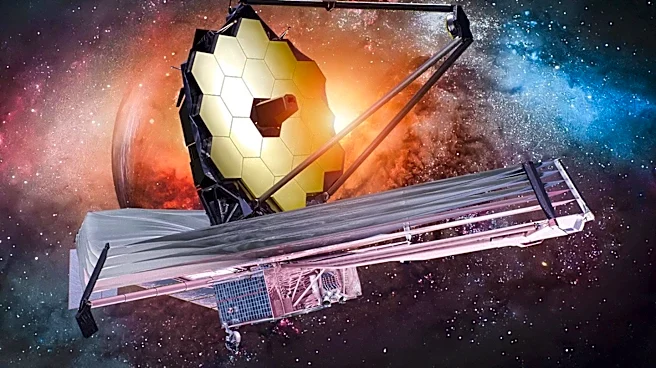
The James Webb Space Telescope (JWST) has detected unexpectedly compact clumps of polycyclic aromatic hydrocarbons (PAHs) in Sextans A, a dwarf irregular galaxy with a metallicity of only 7% of the Sun's. This discovery marks the lowest metallicity detection
of PAH emission to date, challenging existing models that predicted a scarcity of these molecules in such metal-poor environments. The PAH emission clumps measure only 0.5-1.5 arcseconds (3-10 parsecs), explaining why previous instruments lacked the resolution to observe them. Detailed analysis of the mid-infrared spectrum confirmed the presence of PAHs through enhanced emission at specific wavelengths. The data suggest these PAHs are relatively small and neutral, showing no significant alteration by intense radiation fields, unlike those found in higher-metallicity galaxies.
Why It's Important?
This finding is crucial for understanding the formation and survival mechanisms of PAHs in the early universe, where metallicities were significantly lower. The detection in Sextans A suggests that PAHs can form and persist even in extremely metal-poor conditions, which were common during the universe's early stages. This challenges the long-held belief that PAH abundance drastically decreases at low metallicities, prompting a re-evaluation of dust evolution models in metal-poor galaxies. The compact nature of the PAH clumps also indicates they are active sites of in situ growth within dense, well-shielded regions of the interstellar medium, rather than being transported from elsewhere. This insight is vital for interpreting high-redshift observations and building a comprehensive framework for PAH behavior across cosmic time.
What's Next?
The implications of this discovery extend to refining models of star formation and molecular gas presence in galaxies, as PAH emission is an established tracer for these phenomena. Researchers will likely focus on further characterizing the conditions that allow PAHs to form and survive in metal-poor environments. This will involve more detailed spectroscopic and photometric studies of other metal-poor systems using the JWST's enhanced sensitivity and resolution. The goal is to develop a more accurate understanding of the overall life cycle of these small grains and their role in galactic evolution, particularly in the context of the early universe. This will help bridge the gap between current observations and theoretical predictions regarding the chemical composition of nascent galaxies.
Beyond the Headlines
The detection of PAHs in Sextans A has broader implications for our understanding of the chemical complexity of the early universe. PAHs are not just tracers; they also influence heating through the photoelectric effect and regulate ionization balance via nanoparticle-mediated recombination, playing a critical role in the interstellar medium. If PAHs were more prevalent in the early universe than previously thought, it could mean that the chemical and physical processes in nascent galaxies were more complex and efficient than current models suggest. This could impact our understanding of the formation of the first stars and planets, as PAHs are precursors to more complex organic molecules. This discovery opens new avenues for astrobiological research, hinting at the potential for complex chemistry to arise even in seemingly harsh, metal-poor environments.