









What's Happening?
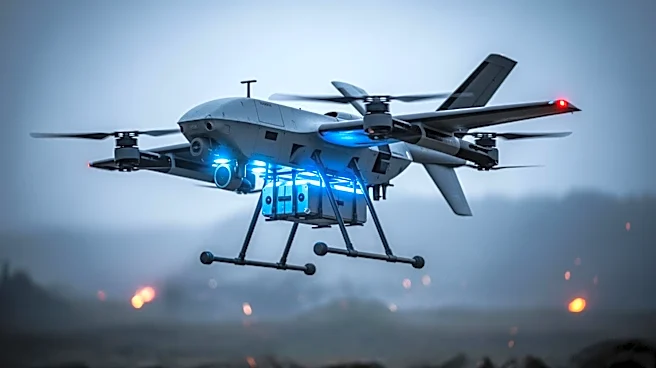
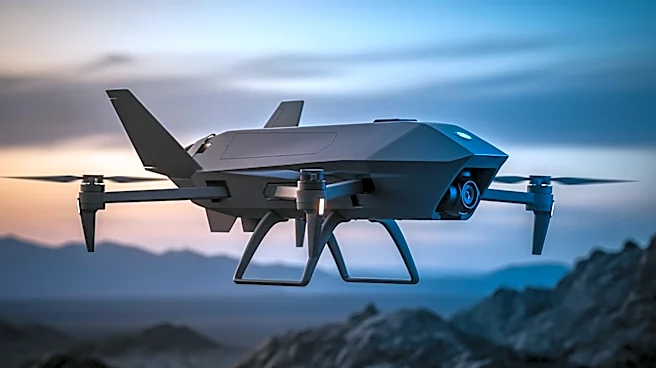
Red Cat Holdings, a U.S.-based provider of drone and robotic solutions, has introduced the Hellcat small unmanned aircraft system (sUAS) at the Eurosatory 2026 exhibition. The Hellcat is designed to meet the U.S. Army's Short Range Reconnaissance program
requirements, offering intelligence, surveillance, and reconnaissance capabilities in dynamic operational environments. Built on the Black Widow platform, the Hellcat is adaptable to various mission needs, featuring a modular design that allows customization of command and control systems, payloads, and software. The sUAS is lightweight, weighing 1.93 kg, and can operate at altitudes over 4,000 feet with a speed of up to 64 km/h. It boasts a range of 11 km and is equipped with advanced sensors, including a three-camera payload for infrared, telephoto, and wide-angle coverage.
Why It's Important?
The introduction of the Hellcat sUAS represents a significant advancement in military reconnaissance technology, providing the U.S. Army with a versatile tool for intelligence gathering. Its modular design and adaptability to various mission requirements enhance its utility in diverse operational scenarios. The Hellcat's ability to function in GPS-denied environments and its low acoustic signature make it a valuable asset for covert operations. This development underscores the growing importance of unmanned systems in modern military strategy, potentially influencing future procurement and deployment strategies within the U.S. defense sector. The collaboration with Ukraine in its development also highlights international cooperation in defense technology innovation.
What's Next?
As the Hellcat sUAS enters the market, it is likely to undergo further testing and evaluation by the U.S. Army to assess its performance in real-world conditions. The system's adaptability suggests potential for integration into various military operations, possibly leading to broader adoption across different branches of the armed forces. Additionally, Red Cat Holdings may explore opportunities to expand the Hellcat's capabilities or develop new variants to meet specific operational needs. The success of the Hellcat could also prompt other defense contractors to innovate and enhance their own unmanned systems, fostering competition and technological advancement in the sector.