



What's Happening?
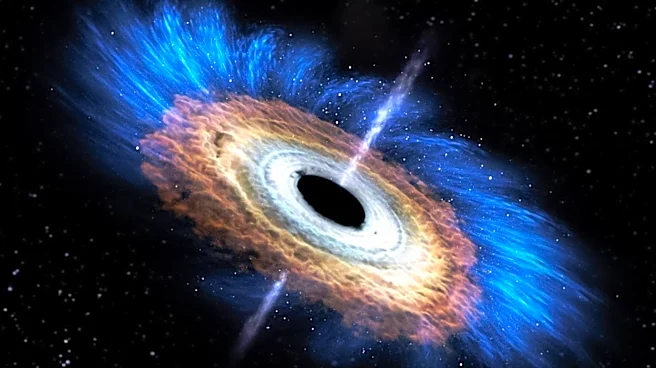
An international collaboration, co-led by Andrew Mummery, a scholar at the Institute for Advanced Study (IAS), and Adelle Goodwin from Curtin University, has identified a universal rule governing the launching of powerful jets from black holes. Their
research, published in Nature Astronomy, reveals that both stellar-mass black holes (approximately ten times the Sun's mass) and supermassive black holes (millions of times heavier) initiate these jets at the same critical points in their feeding cycles. The team analyzed multi-wavelength observations from telescopes worldwide, focusing on tidal disruption events (TDEs), where stars are torn apart by supermassive black holes. These events compress the black hole's feeding episode into a few years, allowing researchers to observe the dynamic process. They found two distinct jet-launching phases: an early phase during extreme feeding and a later phase, hundreds to thousands of days after the star's disruption, when the feeding rate drops to about two percent of the Eddington limit.
Why It's Important?
This discovery is significant because it confirms a long-suspected principle in astrophysics: that black holes, regardless of their immense size variations, adhere to the same fundamental laws of physics concerning jet formation. Previously, studying supermassive black holes was challenging due to their evolutionary timescales spanning thousands or millions of years. By utilizing TDEs, the researchers bypassed this limitation, providing a unique window into these processes. The identification of a universal critical accretion rate for jet formation helps solve the mystery of why some black holes launch jets immediately after consuming a star, while others exhibit a delayed response. This understanding not only advances theoretical astrophysics but also has practical implications for observational astronomy, enabling more efficient use of highly sought-after instruments like radio telescopes.
What's Next?
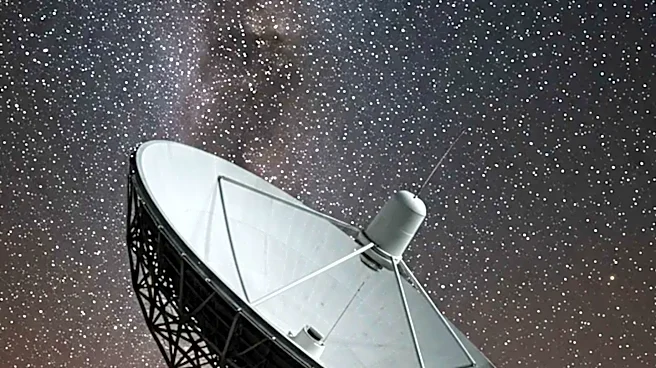
The findings offer practical benefits for astronomers by allowing them to better anticipate when black holes are most likely to launch delayed jets. This predictive capability will enable more targeted observation campaigns, optimizing the use of expensive and in-demand scientific instruments globally. For instance, the Square Kilometre Array (SKA) radio telescope project, set to begin collecting scientific data in 2028, will greatly benefit from this research, ensuring fewer wasted observations and improving the chances of capturing fleeting events. As next-generation surveys detect more TDEs, astronomers will have a clearer physical signal for when to initiate follow-up observations, leading to more efficient and impactful discoveries about the cosmos. The research also paves the way for further profound discoveries about the universe and the fundamental physics governing black holes.
Beyond the Headlines
This research touches upon the fundamental nature of black holes and their influence on galactic evolution. The powerful jets, often described as cosmic 'burps,' blast material across vast distances, playing a crucial role in shaping their host galaxies. The universality of the jet-launching mechanism suggests a deeper, underlying simplicity in the physics governing these extreme cosmic objects, despite their dramatic and chaotic behavior. The study highlights the importance of international collaboration and the serendipitous moments of scientific insight, such as the realization occurring in a Madrid conference bar. Furthermore, the ability to predict these events underscores the growing sophistication of astronomical observation and data analysis, moving towards a more proactive and efficient approach to exploring the universe.