




What's Happening?
Astronomers have discovered a natural sugar, erythrulose, in clouds of interstellar dust and gas near the center of the Milky Way galaxy. This finding marks the first time such a compound, which is key to life, has been identified in space. The research,
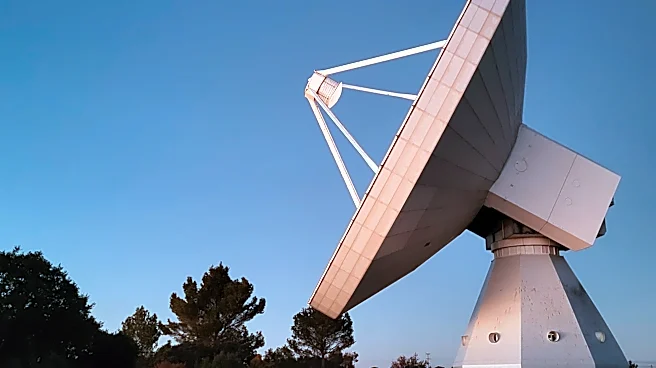
led by a team at Spain’s Center for Astrobiology, utilized radio telescopes to study a molecular cloud known as G+0.693−0.027. The detection of erythrulose, a sugar made of four carbon atoms, was unexpected as it challenges the prevailing view in astrochemistry that interstellar molecules grow by sequentially adding carbon atoms. The study, published in Nature Astronomy, suggests that erythrulose can form from simpler molecules on icy dust grains in space, potentially becoming part of more complex chemical systems.
Why It's Important?
The discovery of erythrulose in interstellar space is significant as it supports the theory that essential organic compounds could have been delivered to Earth via comets and asteroids, potentially seeding the planet with the building blocks of life. This finding fuels optimism that other molecules crucial for the origins of life might also be found in space, offering insights into how life could emerge on other planets. The presence of such sugars in space suggests that the conditions necessary for life might be more common in the universe than previously thought, impacting our understanding of life's potential distribution across the cosmos.
What's Next?
The detection of erythrulose opens the door for further exploration of other complex sugars and organic molecules in space. Researchers may focus on identifying sugars like ribose, which is part of RNA, to better understand the potential for life beyond Earth. This discovery could lead to more targeted searches for life-supporting compounds in other parts of the galaxy, using advanced telescopes and space missions. The scientific community may also explore the implications of these findings for the origins of life on Earth and other planets, potentially revising existing theories about how life began.
Beyond the Headlines
The discovery of sugars in interstellar space highlights the complex chemistry that occurs in the vast expanses between stars. It raises questions about the processes that lead to the formation of life-supporting molecules and the role of cosmic events, such as the Late Heavy Bombardment, in delivering these compounds to planets. This finding also underscores the importance of interdisciplinary research, combining astronomy, chemistry, and biology, to unravel the mysteries of life's origins. The potential for discovering more complex organic molecules in space could have profound implications for our understanding of life's universality and the conditions necessary for its emergence.