







What's Happening?
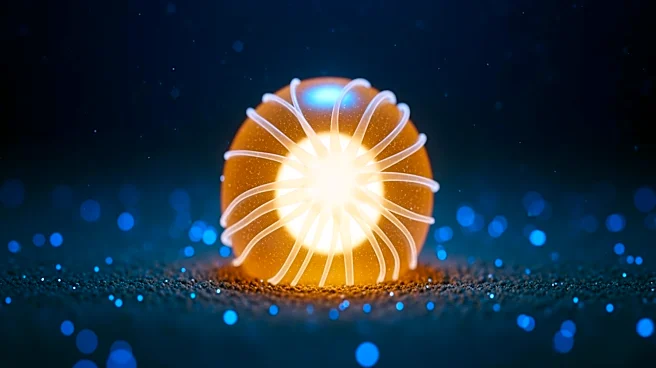
Researchers from NOAA and the Smithsonian have identified a mysterious 'golden orb' discovered in 2023 during a deep-sea expedition in the Gulf of Alaska. Initially speculated to be an alien egg or an unknown species, the object has been confirmed as a remnant
of a rarely seen giant deep-sea anemone, Relicanthus daphneae. The discovery was made using a remotely operated vehicle at a depth of over 3,250 meters. The orb, which appeared as a mound-shaped mass with a small opening, puzzled scientists due to its lack of recognizable animal features. Through a complex investigation involving morphological, genetic, and bioinformatics expertise, the object was found to be composed of fibrous layers with stinging cells, linking it to cnidarians, the group that includes corals and anemones.
Why It's Important?
The identification of the 'golden orb' highlights the ongoing mysteries of deep-sea exploration and the potential for new scientific discoveries. Understanding such unique marine organisms can provide insights into the biodiversity of deep-sea ecosystems and their evolutionary processes. This discovery underscores the importance of continued exploration to unlock the secrets of the ocean, which can have implications for economic growth, national security, and environmental sustainability. The findings also demonstrate the collaborative efforts required in scientific research, involving multiple disciplines to solve complex biological puzzles.
What's Next?
Further exploration and study of deep-sea environments are expected to continue, with the potential for more discoveries that could enhance our understanding of marine biodiversity. The research community may focus on the ecological roles of such organisms and their adaptations to extreme environments. Additionally, the findings could inspire new technologies and methodologies for deep-sea exploration, contributing to the broader field of marine science.