






What's Happening?
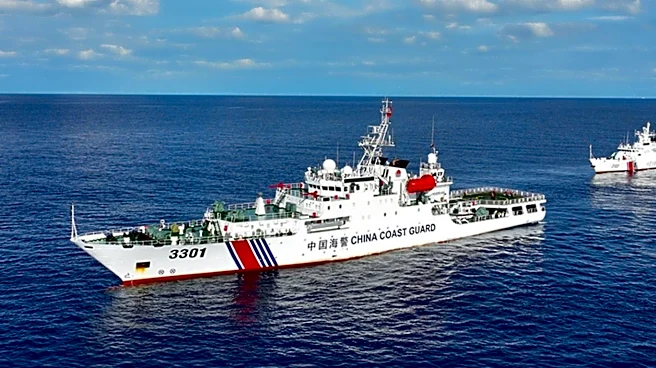
China's military, specifically the People's Liberation Army Southern Theatre Command, announced on Friday that its naval and air forces conducted combat readiness patrols around Scarborough Shoal in the South China Sea. These patrols are described as
a "necessary countermeasure in response to the Philippines' rights-violation and provocative acts." The China Coast Guard also carried out law-enforcement patrols in the same area, echoing the military's justification. China claims sovereignty over nearly the entire South China Sea, marked by a nine-dash line on its maps, which overlaps with the exclusive economic zones of several Southeast Asian nations, including the Philippines. An international arbitral tribunal ruled in 2016 that China's expansive claims lack a basis under international law, a decision Beijing has rejected. Neither the Chinese military nor the China Coast Guard specified the particular Philippine actions that prompted these patrols.
Why It's Important?
These patrols by China's military and coast guard in the South China Sea escalate tensions in a strategically vital waterway. The Scarborough Shoal has long been a flashpoint between Beijing and Manila, and China's actions directly challenge the Philippines, a U.S. treaty ally. The increased military presence and assertive claims by China could destabilize regional security and impact international shipping lanes. For the U.S., this situation underscores the ongoing challenge to freedom of navigation and the rules-based international order in the Indo-Pacific. The Philippines' role as the rotating ASEAN chair, prioritizing a Code of Conduct for the South China Sea, is complicated by China's actions, potentially hindering diplomatic efforts to resolve territorial disputes peacefully. The U.S. has consistently affirmed its commitment to its alliance with the Philippines and to upholding international law in the South China Sea, making these developments a significant concern for U.S. foreign policy and regional stability.
What's Next?
The immediate future will likely see continued monitoring of Chinese and Philippine activities in the South China Sea by international observers and regional powers. The Philippines may issue a formal response to China's latest patrols, potentially seeking support from its allies, including the U.S. Diplomatic efforts within ASEAN to finalize a Code of Conduct for the South China Sea are expected to face further challenges, given China's assertive stance. The U.S. may reiterate its commitment to freedom of navigation and overflight in the region and could potentially increase its own naval presence or joint exercises with allies to counter China's growing assertiveness. The lack of specific details from China regarding the alleged Philippine provocations could lead to further speculation and heightened rhetoric from both sides, making de-escalation more difficult.
Beyond the Headlines
The recurring confrontations in the South China Sea, exemplified by these patrols, highlight a deeper geopolitical struggle for influence and control over critical maritime resources and trade routes. China's rejection of the 2016 international tribunal ruling sets a precedent that undermines international legal frameworks for resolving territorial disputes, potentially encouraging other nations to disregard international law. The U.S. and its allies face the challenge of balancing deterrence against China's expansionist claims with the need to avoid direct military confrontation. The long-term implications include the potential militarization of disputed features, disruption of global supply chains, and a shift in regional power dynamics. The ongoing tensions also raise questions about the effectiveness of multilateral institutions like ASEAN in mediating disputes when a major power like China is unwilling to compromise on its territorial claims.