


What's Happening?
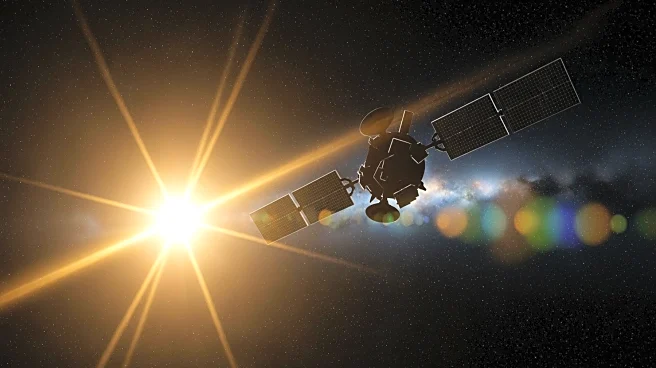
The European Space Agency (ESA) has successfully re-established communication with a spacecraft that is part of its Proba-3 mission, after losing contact a month ago. The Proba-3 mission, launched in 2024, involves two spacecraft flying in precise formation
to simulate a solar eclipse, allowing scientists to study the sun's outer atmosphere, known as the corona. The mission's second spacecraft, equipped with a crucial coronagraph instrument, lost orientation on February 14, causing its solar panel to face away from the sun and depleting its batteries. The spacecraft entered survival mode and had been drifting silently in space. Recently, ESA's team in Spain noticed sunlight hitting the solar panels, providing enough power to re-establish a connection. The spacecraft's solar panel is now correctly oriented, allowing it to recharge its batteries. ESA experts plan to switch the instruments back on and assess any damage.
Why It's Important?
The reconnection with the Proba-3 spacecraft is significant for solar research, as it allows the continuation of studies on the sun's corona, a region that remains largely mysterious. Understanding the corona is crucial for comprehending solar phenomena that can impact Earth's space weather, affecting satellite operations, communications, and power grids. The Proba-3 mission's ability to simulate solar eclipses provides extended observation periods, offering insights that are not possible during the brief natural eclipses on Earth. This development underscores the importance of international collaboration in space exploration and the resilience of space missions in overcoming technical challenges.
What's Next?
ESA plans to conduct tests on the reconnected spacecraft to determine the extent of any damage and ensure its instruments are functioning correctly. The mission aims to resume its scheduled observations of the sun's corona, contributing valuable data to the scientific community. The success of this reconnection may influence future mission designs, emphasizing the need for robust systems capable of recovering from unexpected disruptions. Continued monitoring and analysis will be essential to maximize the scientific output of the Proba-3 mission.