





What's Happening?
U.S. President Donald Trump announced that Israel and Lebanon are set to engage in direct leader-level talks for the first time in 34 years. The discussions are expected to involve Israeli Prime Minister Benjamin Netanyahu and Lebanese President Joseph
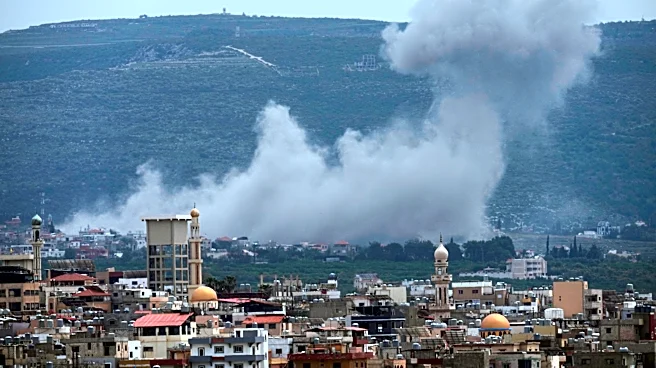
Aoun. This development comes amid ongoing tensions, with recent fire from Lebanon into northern Israel. Diplomatic efforts are being led by U.S. Secretary of State Marco Rubio, who is working on a framework to advance a ceasefire. Despite these efforts, significant challenges remain, particularly regarding the disarmament of Hezbollah, a key demand from Israel. The talks are also complicated by minor border disputes and the symbolic issue of the Shebaa Farms area, which involves Syria. Proposals include creating demilitarized zones in southern Lebanon, but enforcement is a major hurdle.
Why It's Important?
The potential dialogue between Israel and Lebanon marks a significant diplomatic breakthrough, potentially easing decades of tension. The U.S. plays a crucial role in mediating these talks, highlighting its influence in Middle Eastern geopolitics. A successful outcome could stabilize the region, reduce the threat of conflict, and improve security. However, the presence of Hezbollah, an Iran-backed group with substantial military power, poses a significant challenge. Lebanon's current leadership, seen as more willing to confront Hezbollah, adds a new dynamic to the negotiations. The outcome of these talks could impact U.S. foreign policy, regional alliances, and the balance of power in the Middle East.
What's Next?
The immediate focus is on achieving a ceasefire or temporary pause in hostilities. The U.S. will continue to mediate, with Secretary of State Rubio expected to present a framework for further negotiations. The success of these talks depends on Lebanon's ability to address Israel's security concerns, particularly regarding Hezbollah. Future discussions may explore broader security arrangements and the resolution of border disputes. The international community will closely monitor these developments, as they could set a precedent for conflict resolution in the region.
Beyond the Headlines
The talks could redefine Lebanon's political landscape, potentially weakening Hezbollah's influence. This shift might encourage other regional actors to pursue diplomatic solutions to longstanding conflicts. The negotiations also underscore the complexities of Middle Eastern politics, where local disputes are often intertwined with broader geopolitical issues. The outcome could influence U.S. relations with Iran, given Hezbollah's ties to Tehran, and affect the strategic calculations of other regional powers.