






What's Happening?
A new initiative, dubbed Amazon.ia, is being launched with a $100 million investment to track wildlife across the vast Amazon rainforest in real-time using artificial intelligence technology. This project aims to overcome the current limitations in monitoring
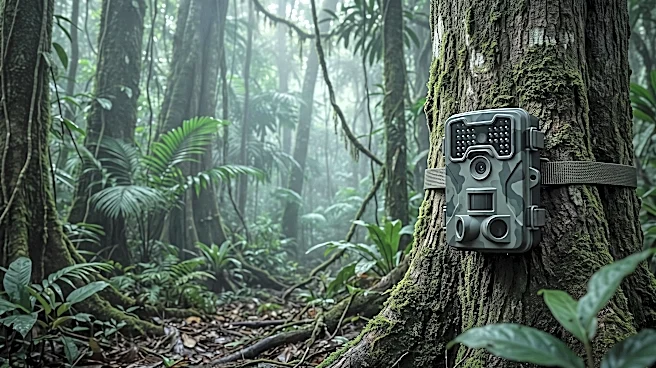
biodiversity, where scientists can track deforestation with satellite imagery but have little insight into the state of wildlife beneath the canopy. The plan involves establishing a network of 10 to 30 core sites across the Amazon, equipped with advanced wildlife-tracking instruments such as camera and audio recorders, and insect traps. The data collected from these sites will be fed into computer models capable of identifying individual species, discerning patterns, and providing a continuous, high-resolution picture of biodiversity trends across the region. Several South American research groups are already involved, with initial sites in Peru, Ecuador, and Brazil. The project has secured approximately $20 million in funding so far, with a significant portion coming from the philanthropic Bezos Earth Fund.
Why It's Important?
This initiative represents a significant leap forward in conservation efforts, addressing a critical gap in understanding the impact of environmental changes on Amazonian wildlife. Currently, while deforestation can be tracked almost daily, the corresponding loss or shift in biodiversity remains largely unknown. By providing real-time, region-wide insights into wildlife populations and their health, Amazon.ia could enable more targeted and effective conservation strategies. This comprehensive data could also galvanize political action by offering concrete evidence of biodiversity changes, which is crucial for policy-making and resource allocation. The project's success could set a precedent for how large-scale ecosystems are monitored globally, potentially influencing U.S. and international conservation policies and funding for similar tech-driven environmental projects. The involvement of U.S. companies like Planet Labs highlights the growing role of American technology and philanthropy in global environmental challenges.
What's Next?
The immediate next steps for the Amazon.ia initiative involve securing the remaining funding to reach its $100 million goal for a 10-year operational period. The project organizers will also focus on expanding the network of data-collecting sites, aiming to establish between 10 and 30 core locations across the Amazon. This will include training local personnel in the various participating countries to manage and utilize the advanced equipment and data analysis tools. Scientists will begin to integrate the incoming data streams with existing geographical maps to develop comprehensive models that can estimate biodiversity trends beyond the immediate observation posts. The project will also need to address technical limitations, such as improving the accuracy of acoustic data to determine population sizes rather than just species presence. The long-term success will depend on the continuous flow of data and the ability to translate complex ecological information into actionable conservation measures and policy recommendations.
Beyond the Headlines
The Amazon.ia project delves into the ethical and practical challenges of leveraging advanced technology for environmental conservation. While promising a 'holy grail' of real-time biodiversity monitoring, it also raises questions about data ownership, accessibility, and the potential for technological solutions to overshadow community-based conservation efforts. The project's reliance on AI and satellite technology highlights a broader shift towards 'big data' approaches in environmental science, which could lead to more efficient resource allocation but also risks creating a disconnect from on-the-ground realities. Furthermore, the initiative's success could influence the valuation of natural capital and the development of new economic models that integrate biodiversity metrics. The potential for region-wide insights could also empower Indigenous communities and local stakeholders by providing them with robust data to advocate for their land rights and traditional conservation practices against external pressures like infrastructure development. However, the challenge remains in ensuring that this technological advancement genuinely serves the diverse needs of the Amazon and its inhabitants.