
What's Happening?
NASA's Artemis 2 mission, which aims to send astronauts to the far side of the moon, has been delayed due to a hydrogen fuel leak discovered during a wet dress rehearsal on February 3, 2026. The Artemis 2 Space
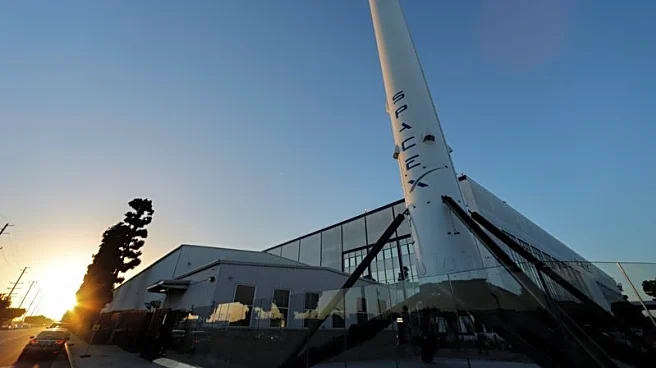
Launch System (SLS) rocket, along with the Orion spacecraft, was fully loaded with propellant to identify and fix potential issues ahead of its scheduled launch. The mission, which will carry NASA astronauts Reid Wiseman, Victor Glover, Christina Koch, and Canadian Space Agency's Jeremy Hansen, is now postponed to no earlier than early March. Meanwhile, SpaceX's Crew-12 Dragon spacecraft, named 'Freedom', successfully launched on February 13, 2026, carrying astronauts to the International Space Station (ISS) for an eight-month mission.
Why It's Important?
The delay of the Artemis 2 mission is significant as it impacts NASA's timeline for returning humans to the moon, a key objective of the Artemis program. The mission's success is crucial for demonstrating the capabilities of the SLS rocket, which is designed to be more powerful than the Saturn V rockets used during the Apollo missions. The delay also highlights the technical challenges involved in preparing for deep space exploration. For the space industry, successful missions like Artemis 2 are vital for maintaining momentum in lunar exploration and for future missions to Mars. The successful launch of SpaceX's Crew-12, however, underscores the growing role of private companies in supporting and advancing space exploration.
What's Next?
NASA will address the hydrogen fuel leak issue to ensure the Artemis 2 mission can proceed safely. The agency will conduct further tests and assessments to prevent similar issues in future launches. The delay may affect subsequent missions in the Artemis program, potentially impacting the timeline for establishing a sustainable human presence on the moon. Stakeholders, including international partners and private companies, will closely monitor NASA's progress, as the success of Artemis 2 is pivotal for future collaborations and investments in space exploration.