
What's Happening?
Italian officials have announced the discovery of a more than 2,000-year-old basilica attributed to Vitruvius, the renowned ancient Roman architect and engineer. This significant archaeological find was
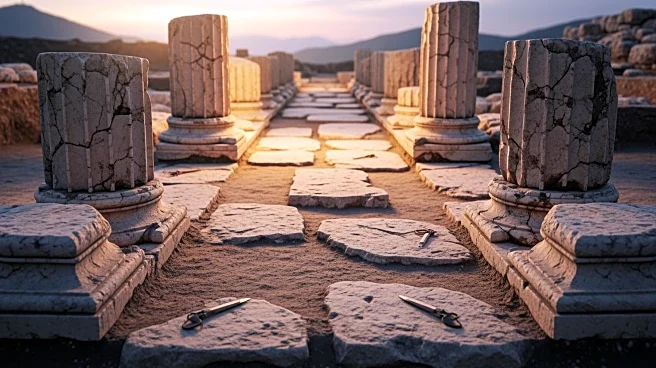
made in the city of Fano, located northeast of Rome. Vitruvius, who lived in the 1st century BC, is celebrated for his work 'De architectura,' the oldest surviving treatise on architecture. His teachings have influenced artists for centuries, including Leonardo da Vinci. The basilica, believed to be a public building, was identified through its precise match with descriptions in Vitruvius' writings. The discovery was hailed as 'sensational' by Italian Culture Minister Alessandro Giuli, who emphasized its historical importance. Archaeologists, led by regional archaeological superintendent Andrea Pessina, confirmed the basilica's layout, which includes a rectangular design with columns, aligning with Vitruvius' descriptions.
Why It's Important?
The discovery of the basilica is considered a major archaeological breakthrough, potentially offering new insights into Roman architecture and engineering. Vitruvius' work has been foundational in the study of classical architecture, and this find could provide tangible evidence of his designs and methodologies. For Italy, this discovery enhances its cultural heritage and could boost tourism, drawing scholars and enthusiasts of ancient history and architecture. The basilica's unearthing also underscores the enduring influence of Roman architectural principles, which continue to inform modern design. This find may lead to further archaeological exploration in the region, potentially uncovering more about the Roman era's architectural practices.
What's Next?
Further excavation is planned to determine the full extent of the basilica and to assess the possibility of making the site accessible to the public. Archaeologists will continue to explore the area to uncover more of the structure and any additional artifacts that may provide further context about its use and significance. The Italian government and local authorities are likely to invest in preserving the site, ensuring its protection and potential as a cultural and educational resource. This discovery may also prompt renewed interest in Vitruvius' work, leading to academic studies and public exhibitions that highlight his contributions to architecture.