





What's Happening?
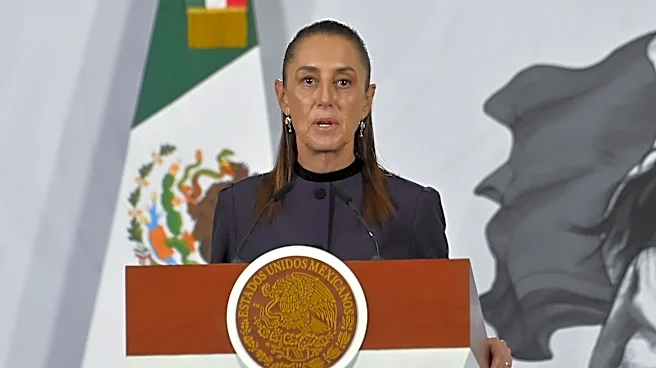
Mexican President Claudia Sheinbaum Pardo has declared the 'Housing for Well-being' program as the largest housing initiative in Mexico's history. The program aims to construct 1.8 million homes, alongside improvement actions and credit facilities, to provide
access to property for approximately 12 million Mexicans, particularly low-income families. During a remote event from Palacio Nacional, President Sheinbaum oversaw the delivery of 72 homes in San Francisco de los Romo, Aguascalientes, part of a development of 152 fully allocated residences. The Secretary of Agrarian, Territorial, and Urban Development, Edna Elena Vega Rangel, reported that Aguascalientes has achieved 38% of its state goal of 24,300 homes. The Director General of Infonavit, Octavio Romero Oropeza, noted that 143 housing complexes are currently being delivered nationwide, with over 50,000 homes already occupied.
Why It's Important?
This housing program represents a significant government effort to address a fundamental social need in Mexico: access to dignified housing. By targeting low-income families and aiming for 1.8 million new homes, the initiative has the potential to substantially improve living conditions for millions of citizens. The program's scale and focus on credit facilities could also stimulate the construction sector, creating jobs and contributing to economic growth. Furthermore, the emphasis on coordination between federal, state, and municipal governments, as highlighted by Governor María Teresa Jiménez Esquivel of Aguascalientes, suggests a comprehensive approach to urban development. The success of 'Housing for Well-being' could serve as a model for future social programs and enhance the government's credibility in delivering on its promises to improve the quality of life for its population.
What's Next?
The 'Housing for Well-being' program is actively progressing, with Aguascalientes already reaching 38% of its state housing goal. Infonavit aims to increase its housing target in Aguascalientes to 20,000 homes, with 8,000 already contracted and an additional 9,000 expected by year-end, which would achieve 86% of the institution's six-year goal in the state. The program will continue to focus on expanding housing options, addressing housing deficits in various regions, and facilitating homeownership for more families. The ongoing coordination between federal and local governments, including the donation of 92 plots of land for new developments in Aguascalientes, indicates a sustained effort to meet the program's ambitious targets. The government will likely continue to monitor progress and adapt strategies to ensure the successful delivery of homes and credits to eligible beneficiaries.
Beyond the Headlines
The 'Housing for Well-being' program, while addressing a critical social issue, also carries broader implications for urban planning and social equity in Mexico. The large-scale construction of 1.8 million homes will necessitate careful consideration of infrastructure, public services, and environmental impact in the areas of development. The program's focus on low-income families could lead to a more equitable distribution of resources and opportunities, potentially reducing social disparities. However, the challenge lies in ensuring the quality and sustainability of these new housing units, as well as preventing issues such as urban sprawl or the creation of isolated communities. The initiative also reflects a shift in government priorities towards social welfare programs, which could have long-term effects on Mexico's economic and social policies. The success of this program will not only be measured by the number of homes built but also by its ability to foster inclusive and sustainable communities.