



What's Happening?
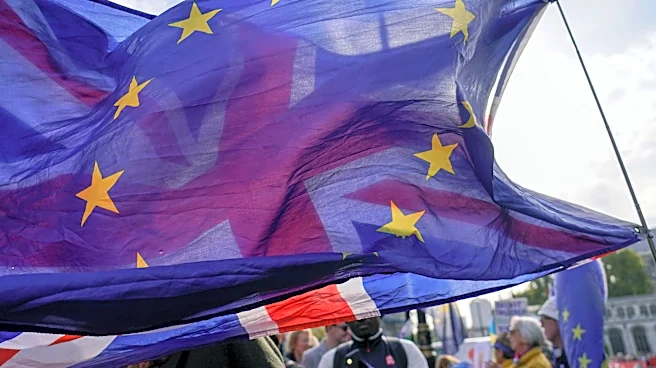
A UK-EU summit in Brussels is set to feature new agreements, with UK Prime Minister Andy Burnham aiming to deliver on a promised EU 'reset' by his predecessor, Keir Starmer. The summit is expected to include discussions on the UK linking up with the EU’s
energy single market, cooperation on migration control, and a closer defense and security relationship. A draft joint statement indicates further talks on these areas. EU officials, however, have cautioned that there are limits to the number of sectoral agreements available, suggesting that the UK needs to decide on its long-term relationship with the EU: whether to join the single market, rejoin the EU, or accept the status quo. The UK government has highlighted potential economic benefits from a 'food & drink' trade deal, estimated at £5.1 billion annually, and an emissions linking agreement, potentially adding £3.8 billion per year.
Why It's Important?
This summit is crucial for defining the future economic and political relationship between the UK and the EU post-Brexit. The proposed agreements, particularly in food and drink trade and emissions linking, could significantly impact UK businesses by reducing paperwork and protecting industries like steel and aluminum from the EU’s carbon border adjustment mechanism. A digital partnership covering AI and digital identities, along with a Youth Experience Scheme, also signals efforts to deepen cooperation. However, the EU's insistence that the UK clarify its long-term ambitions—whether to seek closer integration or maintain the current distance—underscores the ongoing uncertainty for businesses and citizens. The outcome will influence trade flows, regulatory alignment, and the UK's strategic position in Europe and globally.
What's Next?
The summit is expected to lead to further discussions and potential agreements in specific sectors. The agreement to align agrifood standards, set to scrap border controls by March 2028, and the launch of a digital partnership in early 2027, indicate a path towards incremental cooperation. However, the UK's main priorities, such as inclusion in the EU's 'Made in Europe' industrial support scheme and participation in the 'Security Action for Europe' instrument, are likely to face delays. These require alignment with evolving EU laws and could necessitate the UK imposing tariffs on Chinese electric vehicles, mirroring EU policy. The EU's call for the UK to make a definitive choice on its future relationship suggests that the current 'cherry-picking' approach may have reached its limits, pushing for a more comprehensive decision.
Beyond the Headlines
The ongoing negotiations between the UK and the EU reflect a broader struggle to define national sovereignty and economic integration in a post-Brexit world. The EU's firm stance on the UK's long-term commitment highlights the challenges of maintaining a close relationship without full membership or alignment. The discussions on industrial support schemes and trade protection measures, particularly concerning Chinese imports, reveal the complex geopolitical and economic pressures influencing both blocs. This situation could lead to a more defined, albeit potentially more restrictive, framework for UK-EU relations, impacting not only trade but also broader strategic alliances and regulatory environments for years to come.