






What's Happening?
Laguna Beach officials are applying for funding from the Orange County Transportation Authority (OCTA) to synchronize traffic lights along a 12-mile stretch of the Pacific Coast Highway (PCH) in Laguna Beach and Dana Point. The proposed project aims to synchronize 24
traffic lights in Laguna Beach and 16 in Dana Point, extending from School/State Park in Laguna Beach to Doheny Road in Dana Point. If approved, the project would receive approximately $2,688,000, or 80% of its cost, through a grant from Measure M2. Laguna Beach and Dana Point would then split the remaining costs, with Laguna Beach covering slightly over $400,000. Laguna Beach Assistant City Engineer Tran Tran stated that the goal is not to create a perpetually green corridor but to optimize signal timing to reduce stops, improve efficiency, and decrease vehicle emissions. CalTrans will own and maintain the 24 traffic signals within Laguna Beach and has already expressed support for the deal.
Why It's Important?
This initiative is significant for commuters and residents in Orange County, particularly those who frequently travel along the Pacific Coast Highway. Reduced traffic congestion and delays would lead to shorter travel times, directly benefiting individuals' daily commutes and overall quality of life. Economically, more efficient traffic flow can reduce fuel consumption and vehicle wear, saving money for drivers. The project also aims to lower greenhouse gas emissions and improve air quality, aligning with broader environmental goals and potentially leading to public health benefits. For local businesses, improved traffic flow could make areas more accessible and attractive to customers. The collaboration between Laguna Beach, Dana Point, and CalTrans highlights a regional approach to infrastructure challenges, setting a precedent for future inter-agency cooperation on transportation projects.
What's Next?
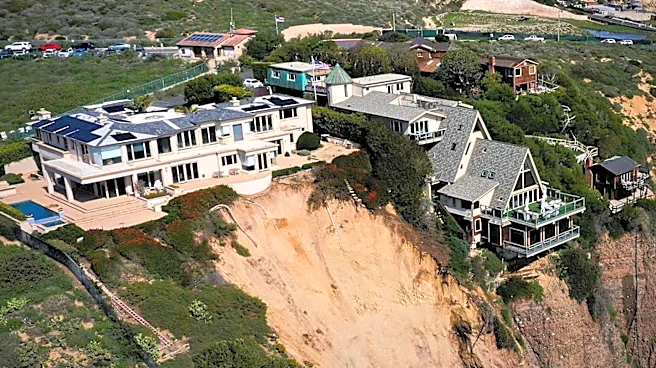
Laguna Beach's application for funding from the Orange County Transportation Authority is the immediate next step. If the grant is approved, city leaders in Laguna Beach would need to greenlight the project to cover their share of the remaining costs. Once funding is secured and approvals are in place, the project is anticipated to take approximately one year to complete from its groundbreaking. The proposed infrastructure includes remote access to signals for real-time timing adjustments, video cameras for monitoring traffic, pedestrians, and bicycles, and the incorporation of an emergency evacuation plan to remotely administer greenlights during emergencies. Councilmember Bob Whalen emphasized the importance of updated traffic counts for data collection, suggesting these should be conducted after the Pacific Coast Highway at El Morro reopens following a crack along the bluff, to ensure accurate data reflecting normal traffic flow.
Beyond the Headlines
The project's focus on synchronizing traffic lights goes beyond simply moving vehicles faster; it represents a strategic effort to enhance urban mobility by reducing idling and associated emissions, contributing to a more sustainable transportation system. The integration of remote access and real-time monitoring capabilities signifies a move towards smart city infrastructure, allowing for dynamic responses to changing traffic conditions and potential emergencies. This approach could serve as a model for other congested urban corridors in the U.S., demonstrating how technology and inter-agency cooperation can address complex transportation issues. The emphasis on environmental benefits, such as reduced greenhouse gas emissions and improved air quality, also reflects a growing awareness of the ecological impact of urban planning and the need for sustainable solutions in infrastructure development.