






What's Happening?
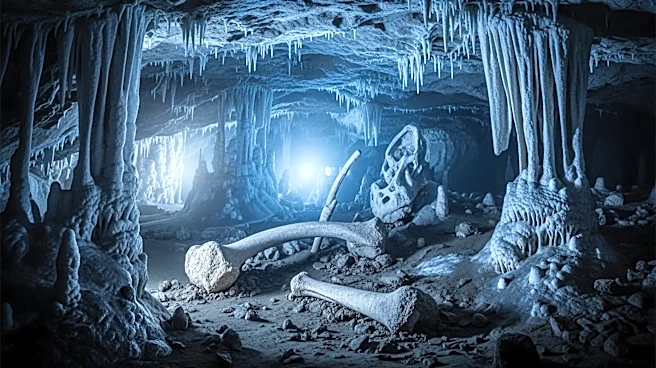
Paleontologists have uncovered a significant collection of Ice Age megafauna in Bender’s Cave, Comal County, Texas. The discovery, led by John Moretti from the University of Texas at Austin, began when local spelunker John Young photographed bones while
snorkeling in the cave. This prompted a multi-year study, revealing fossils of species such as saber-toothed cats, mastodons, and mammoths. Notably, the team found remains of a giant tortoise and a pampathere, a lion-sized armadillo relative, marking the first records of these species in the Edwards Plateau. The fossils, heavily mineralized and coated in calcite, suggest prolonged exposure to the cave's carbonate-rich groundwater. The findings, published in Quaternary Research, challenge existing knowledge of the region's prehistoric ecology, suggesting a warmer, more diverse environment than previously thought.
Why It's Important?
This discovery is pivotal as it challenges the established understanding of the Edwards Plateau's ecological history during the last glacial period. The presence of species like the giant tortoise and pampathere, which are typically associated with warmer climates, suggests that the region may have experienced different environmental conditions than previously documented. This could lead to a reevaluation of the paleoenvironmental records and influence future research on climate and ecological changes in North America. The findings also highlight the potential for undiscovered biodiversity in similar unexplored regions, prompting further paleontological investigations.
What's Next?
Researchers are now focusing on uranium-thorium dating of cave mineral formations on the fossils to establish a more reliable timeline for when these species inhabited the region. This method could provide a minimum age for the bones, offering insights into the climatic conditions of the time. The study's results may prompt additional explorations in other caves and regions, potentially uncovering more about the prehistoric ecosystems of North America. The scientific community may also engage in discussions to reassess the ecological history of the Edwards Plateau and similar areas.
Beyond the Headlines
The discovery raises questions about the adaptability and migration patterns of Ice Age megafauna in response to climatic shifts. It also underscores the importance of interdisciplinary approaches in paleontology, combining geology, climatology, and biology to reconstruct past environments. The findings could influence conservation strategies by providing historical context for current biodiversity and climate change challenges. Additionally, the study highlights the role of citizen scientists, like John Young, in contributing to significant scientific discoveries.