



What's Happening?
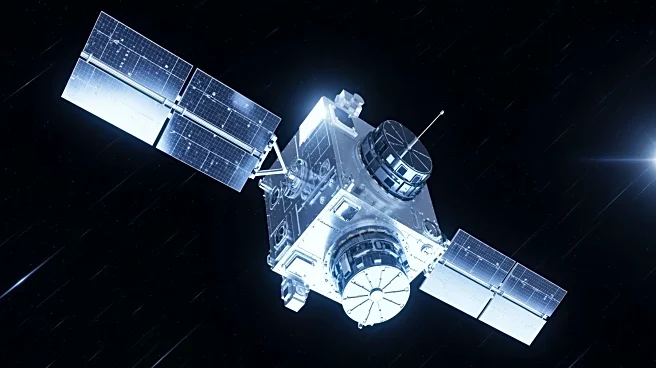
NASA's Interstellar Mapping and Acceleration Probe (IMAP) mission has successfully recorded its first measurements in space, marking a significant milestone known as 'first light.' The spacecraft, equipped with ten instruments, is now collecting preliminary
science data as it travels to its observational post at Lagrange point 1 (L1), approximately 1 million miles from Earth towards the Sun. The IMAP mission aims to chart the boundaries of the heliosphere, a vast bubble created by the Sun's wind that encompasses the solar system, and study its interaction with the local galactic environment. The mission's instruments, including IMAP-Lo, IMAP-Hi, and IMAP-Ultra, measure energetic neutral atoms (ENAs) to map the heliosphere's boundaries. These initial observations have already provided valuable data, showcasing the mission's potential to enhance understanding of space weather and its effects on Earth.
Why It's Important?
The IMAP mission's successful 'first light' is crucial for advancing space weather forecasting, which is vital for protecting astronauts and spacecraft from harmful solar radiation. By providing near-real-time solar wind measurements, IMAP supports the IMAP Active Link for Real-Time (I-ALiRT) system, offering approximately 30 minutes of warning for space weather events. This capability is essential for ensuring the safety of space missions and maintaining the functionality of satellites and other space-based technologies. Additionally, the mission's ability to map the heliosphere's boundaries contributes to a deeper understanding of the solar system's interaction with the broader galaxy, which has implications for both scientific research and practical applications in space exploration.
What's Next?
As IMAP continues its journey to L1, the mission is finalizing its commissioning phase and instrument calibration. The spacecraft is expected to reach its operational post in early January, with the goal of commencing regular science operations by February 1, 2026. The mission will continue to refine its data collection processes, enhancing its ability to provide critical space weather forecasts. Stakeholders, including NASA and the broader scientific community, will likely monitor the mission's progress closely, as its findings could influence future space exploration strategies and policies.