



What's Happening?
One year after the assassination of conservative activist Charlie Kirk on September 10, 2025, the conservative movement is reportedly experiencing significant fracturing and a decline in unity. Kirk, who was a prominent figure and leader of the right-wing
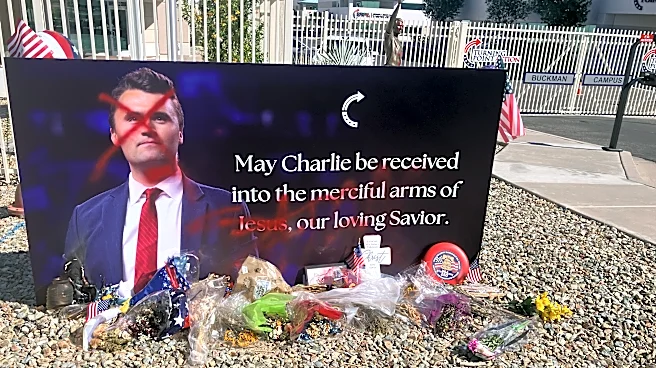
'podcast-class,' was assassinated while speaking at Utah Valley University. His death, initially hoped to be a catalyst for change and unity, has instead led to increased internal divisions within the conservative coalition. The article highlights that while Kirk's organization, Turning Point USA (TPUSA), continues its mission, the broader movement has struggled to maintain the cohesion he once fostered. The memorial for Kirk outside TPUSA headquarters was vandalized on September 13, 2026, further underscoring the contentious environment surrounding his legacy. The author, a Christian pastor, expresses devastation over Kirk's death and observes that the movement he championed is in worse shape as of September 2026.
Why It's Important?
The reported disunity within the conservative movement following Charlie Kirk's assassination carries significant implications for U.S. politics and public discourse. Kirk was described as a unifying figure who brought together diverse elements of the right-wing, including figures like RFK Jr. and Tulsi Gabbard, during the 2024 election cycle. His absence has led to what is termed the 'podcast wars,' where internal disagreements have escalated, and the coalition has fractured. This fragmentation could weaken the conservative political force, potentially impacting future elections, policy debates, and the ability to present a united front on key issues. The article suggests that without a central unifying voice, the movement risks becoming more susceptible to internal conflicts and less effective in achieving its objectives, thereby influencing the broader political landscape and the balance of power in the U.S.
What's Next?
In the wake of Charlie Kirk's assassination, the immediate future for the conservative movement appears to involve continued efforts to address internal divisions and redefine its direction. The article suggests that honoring Kirk's legacy requires finding a way to reunite the Right and engage in robust dialogue, rather than succumbing to the 'TikTok-ification' of discourse characterized by short-form, click-motivated content and conspiracy theories. Stakeholders within the movement, including TPUSA, are expected to continue their work, but the challenge remains in fostering unity among disagreeing members. The author calls for individuals to uphold the values Kirk championed, such as getting married, having children, attending church, and fighting for the country. The long-term trajectory will depend on whether a new unifying figure emerges or if the various factions can independently find common ground to rebuild the coalition.
Beyond the Headlines
Beyond the immediate political ramifications, Charlie Kirk's assassination and the subsequent disunity within the conservative movement highlight deeper societal and cultural shifts. The article touches upon the 'TikTok-ification' of discourse, where complex issues are reduced to short, often sensationalized content, leading to a decline in robust dialogue and an increase in conspiracy theories. This trend has broader implications for how information is consumed and debated in the U.S., potentially eroding critical thinking and fostering an environment of distrust. Furthermore, Kirk's role as a 'great man' who advocated for traditional values, such as marriage and fatherhood, underscores a cultural concern about the absence of strong male role models. His death, therefore, not only impacts political organization but also reflects and potentially exacerbates ongoing debates about societal values, the nature of public discourse, and the search for unifying figures in a fragmented world.