



What's Happening?
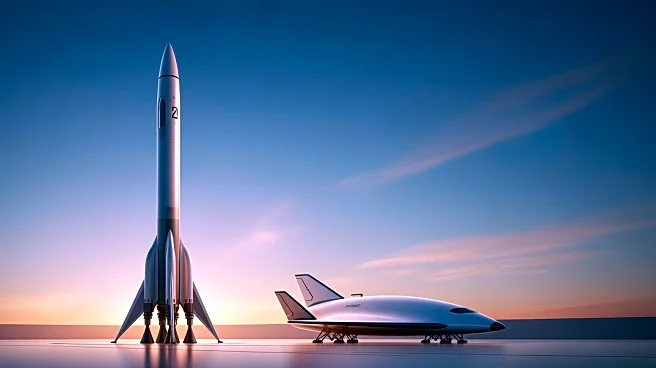
Chinese launch firm CAS Space is preparing for the inaugural launch of its reusable Kinetica-2 liquid rocket, scheduled for late March. The launch will take place from the Jiuquan Satellite Launch Center in the Gobi Desert and will carry a prototype of the Qingzhou-1
cargo spacecraft. This spacecraft is being developed by the Innovation Academy for Microsatellites of the Chinese Academy of Sciences (IAMCAS) as part of a program initiated by China’s human spaceflight agency, CMSEO, to support the Tiangong space station. The Kinetica-2 rocket is designed to carry up to 12,000 kilograms to low Earth orbit and features reusability capabilities. CAS Space, a commercial spinoff from the Chinese Academy of Sciences, plans to conduct three more Kinetica-2 launches in 2026, including missions for internet megaconstellations.
Why It's Important?
The launch of the Kinetica-2 rocket marks a significant step in China's efforts to enhance its space capabilities and increase its launch cadence. The development of reusable rockets like the Kinetica-2 is crucial for reducing the cost of space missions and increasing the frequency of launches. This advancement could position China as a more competitive player in the global space industry, potentially impacting international collaborations and market dynamics. The successful deployment of the Qingzhou-1 cargo spacecraft prototype also supports China's ambitions to maintain and expand its presence in space, particularly with the Tiangong space station. This could have implications for international space station collaborations and the future of space exploration.
What's Next?
Following the Kinetica-2 launch, CAS Space plans to conduct additional launches throughout 2026, including missions for internet megaconstellations and other national projects. The company is also working on establishing a space tourism service, having conducted a suborbital launch and capsule landing test in January. These developments suggest a continued focus on expanding China's commercial space capabilities and exploring new markets. The success of these initiatives could lead to increased competition in the global space industry and influence future international space policies and collaborations.