





What's Happening?
Republican Congressman Mario Díaz-Balart has asserted that the Cuban regime will not survive the remainder of President Trump's term. In an interview with NTN24, Díaz-Balart stated his conviction that the regime is 'dead' and lacks popular support, describing
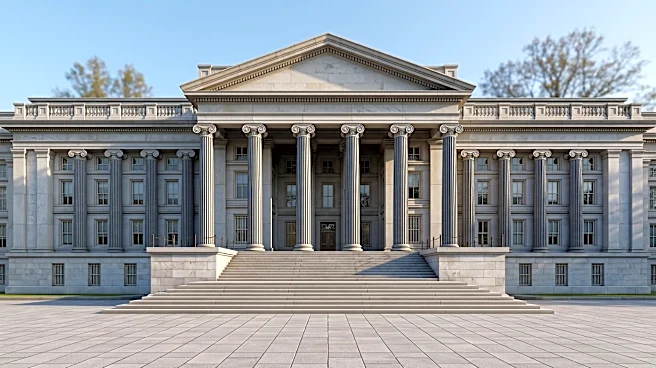
it as corrupt and murderous. He criticized Cuban leaders for maintaining luxurious lifestyles while the general population suffers. Díaz-Balart also claimed that the Cuban military conglomerate GAESA holds between $18 billion and $20 billion in cash that is not used to benefit the Cuban people. His comments come as the Trump administration continues to intensify economic pressure and sanctions against Havana, with the latest round announced on September 3 by the Office of Foreign Assets Control (OFAC) of the Treasury Department. These sanctions targeted Fidel Ernesto Castro Calis, grandson of Fidel Castro, and five Cuban entities, including the Banco Exterior de Cuba and several state-owned companies in the energy sector.
Why It's Important?
Congressman Díaz-Balart's strong statements underscore the ongoing and escalating U.S. policy of economic pressure against the Cuban government. This approach aims to weaken the regime's capacity for repression by limiting its financial resources. The targeting of key state-owned enterprises, particularly in the energy sector, could significantly impact Cuba's economy and its ability to provide essential services to its citizens. For the U.S., this policy reflects a continued commitment to supporting democratic change in Cuba, aligning with the interests of Cuban-American communities and human rights advocates. The effectiveness of these sanctions in achieving regime change remains a subject of debate, but they represent a significant tool in U.S. foreign policy towards Cuba, potentially influencing regional stability and U.S. relations with other Latin American nations.
What's Next?
The Trump administration is expected to continue its policy of economic pressure and sanctions against the Cuban regime. Congressman Díaz-Balart indicated that the U.S. should do 'whatever it takes' to remove the current government in Havana. This suggests that further sanctions and measures could be implemented, potentially targeting more individuals and entities linked to the Cuban leadership or its economic structures. The impact of these ongoing pressures on the Cuban population and the regime's stability will be closely monitored. Additionally, discussions between U.S. lawmakers, such as Díaz-Balart, and the Trump administration are likely to continue regarding strategies to prevent the deportation of Cubans, indicating a multi-faceted approach to U.S.-Cuba relations.
Beyond the Headlines
The assertion that the Cuban regime is 'dead' but needs to be 'buried' highlights a deeper ideological conflict and the long-standing U.S. objective of promoting democracy in Cuba. This perspective views the current Cuban government as illegitimate and unsustainable, despite its continued existence. The focus on the alleged wealth of the Cuban elite, contrasted with the struggles of the general population, raises ethical questions about the distribution of resources and the impact of governance on human welfare. The U.S. strategy of economic sanctions, while intended to pressure the regime, also carries the risk of exacerbating hardships for ordinary Cubans, leading to complex humanitarian considerations. This situation reflects a broader geopolitical struggle, where economic tools are used to influence political outcomes, with significant implications for human rights and international relations.