
What's Happening?
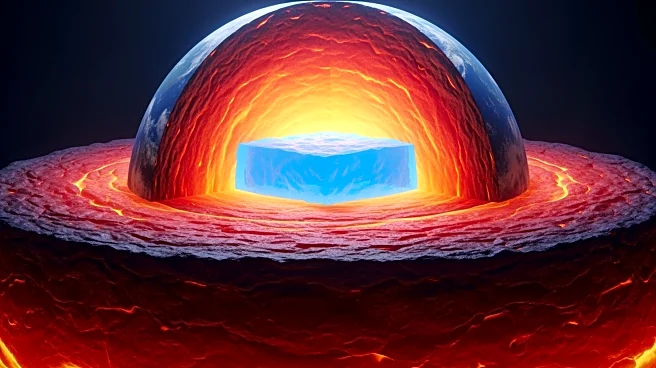
A recent study published in Science reveals that a common deep-Earth mineral, bridgmanite, can store significant amounts of water under extreme conditions. This finding suggests that Earth's largest water reservoir
may be located deep within the mantle, rather than on the surface. Researchers from the Carnegie Institution for Science conducted high-pressure, high-temperature experiments to simulate conditions in the Earth's lower mantle, discovering that bridgmanite absorbs more water as temperatures rise. This challenges the traditional view that Earth's water was primarily delivered by comets or asteroids, suggesting instead that water may have been incorporated into the planet from its formation.
Why It's Important?
This discovery has profound implications for our understanding of Earth's water cycle and geological processes. If the mantle holds vast amounts of water, it could significantly influence mantle convection, plate tectonics, and volcanic activity. The study also challenges the dominant theory of water delivery to Earth, supporting the idea of 'wet accretion' where water was part of Earth's initial formation. This could reshape our understanding of planetary formation and habitability, suggesting that other rocky planets might also harbor internal water reservoirs, even if their surfaces appear dry.
What's Next?
Further research is needed to confirm the extent of water storage in Earth's mantle and its impact on geological processes. Advanced lab techniques and seismic studies could provide more insights into the mantle's hydration levels. This research could also influence the search for habitable exoplanets, as internal water reservoirs might be a common feature of rocky planets. Understanding Earth's deep water cycle could also improve models of planetary cooling and long-term climate regulation, offering new perspectives on Earth's geological history and future.