



What's Happening?
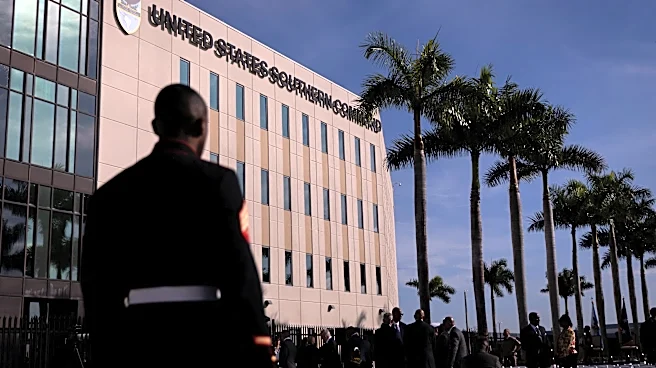
U.S. General Francis Donovan, head of the U.S. Southern Command, conducted a rare meeting with senior Cuban military officials at the perimeter of the U.S. Naval Station Guantanamo Bay, Cuba. This meeting, confirmed by the U.S. military, involved discussions
on operational security matters with Cuban General Roberto Legra Sotolongo, the first deputy minister of the chief of the General Staff. The discussions included a perimeter security assessment of the naval base, focusing on force protection, safety of service members and their families, and operational readiness. This engagement marks the first such meeting by a head of Southern Command in recent memory and comes amid heightened concerns in Cuba about a potential U.S. military attack. The Cuban armed forces acknowledged the meeting on social media, noting that it was conducted with mutual agreement and that both sides agreed to maintain communication.
Why It's Important?
This meeting is significant as it represents a rare instance of direct military communication between the U.S. and Cuba, two countries with a historically tense relationship. The engagement could be seen as a step towards reducing tensions and preventing misunderstandings that could escalate into conflict. For the U.S., maintaining open lines of communication with Cuba is crucial, especially given the strategic importance of Guantanamo Bay. For Cuba, the meeting may help alleviate fears of a U.S. military intervention, which have been heightened by recent U.S. military activities in the region. The dialogue could also influence broader U.S.-Cuba relations, potentially impacting diplomatic and economic interactions.
What's Next?
The continuation of communication between the U.S. and Cuban military officials could lead to further engagements aimed at enhancing mutual understanding and security cooperation. Both countries may explore additional confidence-building measures to address security concerns and prevent potential conflicts. The outcome of these discussions could influence future U.S. foreign policy decisions regarding Cuba, especially under the current administration's focus on foreign policy goals. Observers will be watching for any shifts in U.S. military posture in the region and any reciprocal actions by Cuba.