

What's Happening?
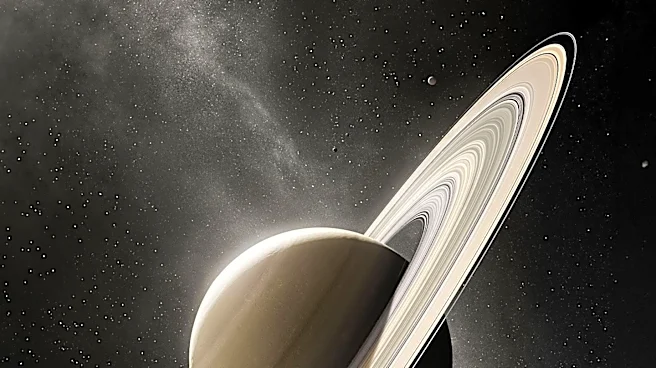
Astronomers have directly measured the mass of a Saturn-mass object, designated KMT-2024-BLG-0792/OGLE-2024-BLG-0516, that appears to be drifting through the Milky Way without a host star. This object, weighing approximately 0.22 Jupiter masses (or 70
Earth masses), was detected through a short gravitational microlensing event observed by Earth-based telescopes and the Gaia spacecraft. The event, which lasted less than a day, involved the object passing in front of a background red giant, bending and magnifying its light. The absence of a lensing signature from a host star suggests the object is either gravitationally unbound or on a very wide orbit. This measurement provides concrete evidence of a planetary-mass object existing independently in space, supporting earlier population models that theorized the existence of numerous such bodies.
Why It's Important?
This discovery is significant because it provides direct observational evidence for free-floating planetary-mass objects, which have previously been largely theoretical. The finding supports the hypothesis that such objects could be far more common than stars, with some estimates suggesting they might outnumber stars by as much as 20 to one. This has profound implications for our understanding of planet formation and evolution, suggesting that many planets may be ejected from their protoplanetary disks rather than remaining in stable orbits around a star. The existence of a vast population of these 'rogue' planets could also influence galactic dynamics and the distribution of matter in the universe. Furthermore, it opens new avenues for astrobiological research, as some theories propose that these free-floating worlds could potentially harbor subsurface oceans and even life, sustained by internal geological heat.
What's Next?
The NASA Nancy Grace Roman Space Telescope's microlensing program is designed to build a much larger sample of these free-floating objects, with enhanced sensitivity to lower-mass lenses. This future mission will provide more robust statistical constraints on their abundance and mass distribution. Researchers will continue to analyze event durations, finite-source effects, and parallax measurements to determine individual masses and search for potential host stars in favorable cases. The next critical step is to determine the shape of the mass distribution for these objects: whether it continues to rise steeply below Earth mass, as some current models imply, or if it turns over in the terrestrial regime, as predicted by certain planet formation simulations. This will help refine our understanding of how these objects form and are distributed throughout the galaxy.
Beyond the Headlines
The detection of a Saturn-mass object without a host star challenges traditional views of planetary systems and highlights the dynamic and often violent processes of planet formation. The concept of 'rogue planets' roaming interstellar space raises intriguing questions about the potential for life beyond star-bound systems. If these objects are indeed abundant, they could represent a significant, yet largely unexplored, component of the galaxy's total mass. This discovery also underscores the power of microlensing as an astronomical tool, capable of detecting objects that are otherwise invisible. The ongoing research into these free-floating worlds could lead to a paradigm shift in exoplanetary science, moving beyond the study of planets orbiting stars to encompass a broader understanding of planetary bodies in all their forms and environments.