


What's Happening?
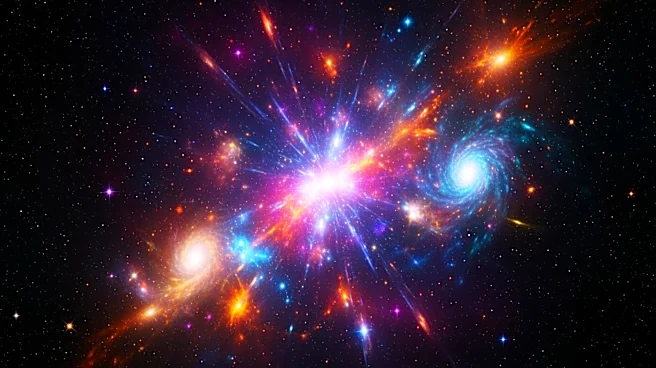
Astronomers have potentially identified a new type of cosmic explosion, termed a 'superkilonova,' which may occur when a kilonova is triggered by a supernova. This discovery stems from observations of an event named AT2025ulz, which initially appeared
similar to the 2017 kilonova but later exhibited characteristics of a supernova. The event was detected through gravitational waves by LIGO and Virgo, and further observed by telescopes worldwide. The findings, led by Caltech's Mansi Kasliwal, suggest that this event could represent a new class of cosmic phenomena, although more evidence is needed to confirm this hypothesis.
Why It's Important?
The potential discovery of a superkilonova could significantly impact our understanding of cosmic events and the formation of heavy elements in the universe. This new type of explosion, if confirmed, would challenge existing models of stellar evolution and the lifecycle of neutron stars. It could also provide insights into the conditions necessary for such events, influencing future astronomical research and observation strategies. The implications extend to the broader field of astrophysics, where understanding the mechanisms behind these explosions could lead to new theories about the universe's evolution.
What's Next?
Further research and observation are required to confirm the existence of superkilonovae. Astronomers will need to identify more events similar to AT2025ulz to gather sufficient evidence. Upcoming projects like NASA's Nancy Roman Space Telescope and Caltech's Deep Synoptic Array-2000 may play crucial roles in this endeavor. The scientific community will likely focus on refining detection methods and exploring the theoretical underpinnings of these potential new cosmic phenomena.