


What's Happening?
The Philippines is in advanced discussions with India to significantly increase its acquisition of BrahMos supersonic cruise missiles, with a potential deal valued between $700 million and $800 million. This proposed package would nearly double Manila's
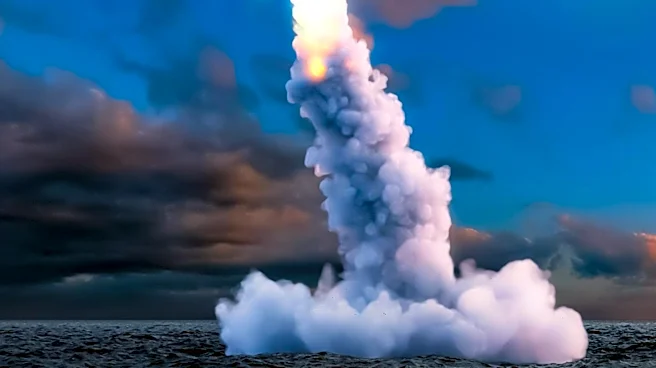
existing order, which was a $375 million deal in 2022 for three batteries of the shore-based, anti-ship variant of the BrahMos missile. Philippine Defense Secretary Gilberto Teodoro Jr. indicated that Manila has provided India with a 'wish list' for modifications to better suit the country's unique infrastructure and geography, particularly concerning the movement of heavy missile equipment across its islands. The acquisition aims to bolster the Philippines' coastal defense capabilities, especially in the context of ongoing territorial disputes with China in the South China Sea. The BrahMos missile, co-developed by India and Russia, is a high-speed, precision, stand-off supersonic cruise missile capable of being launched from various platforms.
Why It's Important?
This expanded missile acquisition is crucial for the Philippines as it seeks to establish a credible deterrence against China's growing maritime presence and assertive actions in the South China Sea. The BrahMos missiles introduce an asymmetric deterrence capability, focusing on anti-access/area denial (A2/AD) tactics, which can help offset the Philippines' military imbalance with China. For the U.S., a treaty ally of the Philippines, this development is significant. While Washington generally discourages allies from using Russian-origin systems due to sanctions, its active support for Manila in operationalizing BrahMos demonstrates a prioritization of countering Chinese maritime power over reservations about Russian technology. The U.S. has been cooperating with the Philippines to integrate these Indian-supplied missiles into a broader coastal-defense and long-range strike architecture, as evidenced by joint maritime-strike training exercises simulating BrahMos employment. This cooperation underscores a strategic alignment to enhance regional security and stability in the Indo-Pacific.
What's Next?
Final-stage talks are underway for the expanded BrahMos missile package, and a signed agreement would clarify the exact number of systems, delivery schedules, and support provisions. The Philippines is expected to continue integrating these missiles into its defense strategy, potentially involving the Philippine Army in addition to the Marine Corps Coastal Defense Regiment. This would necessitate decisions on sector responsibility, training standards, and access to common surveillance. Joint exercises with the United States, such as the Balikatan scenarios, will likely continue to refine the operational coordination and integration of these missile systems. The success of this expanded procurement and its integration will serve as a test case for India's defense export ambitions under its 'Act East' policy and could influence other Southeast Asian nations considering similar acquisitions, potentially leading to a broader 'BrahMos Belt' in the Indo-Pacific.
Beyond the Headlines
The Philippines' reliance on a missile system with Russian origins, despite its status as a U.S. treaty ally, highlights the complex geopolitical landscape of the Indo-Pacific. This pragmatic approach by Manila, supported by Washington, indicates a strategic flexibility where immediate security needs against a common challenge (China) can override traditional alliance-based procurement preferences. The deployment of these advanced missile systems also raises questions about the long-term implications for regional arms races and the potential for escalation in disputed territories. Furthermore, the logistical challenges of deploying and maintaining heavy missile equipment across an archipelago of over 7,600 islands will test the Philippines' infrastructure and operational readiness, requiring significant investment in transport routes, staging areas, and command links. The effectiveness of this deterrence will ultimately depend on Manila's ability to maintain ready batteries, identify targets, and convince adversaries of its willingness to use these capabilities.