
What's Happening?
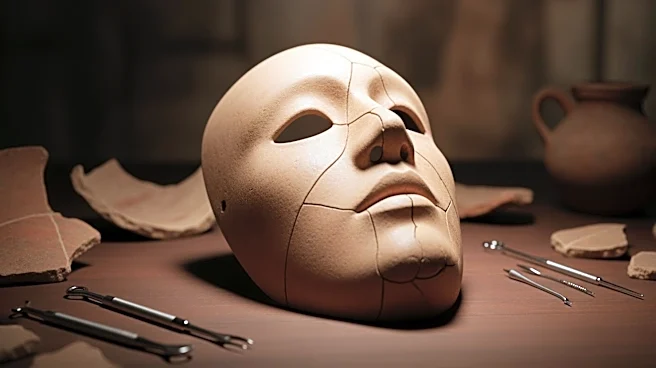
A team of researchers has digitally reconstructed the face of a woman from the Mycenaean period, approximately 3,500 years ago, using a clay mold of her skull. This project, led by historian Dr. Emily
Hauser, utilized forensic anthropology, carbon dating, 3D printing, and DNA analysis. The woman, previously thought to be the wife of a man buried with her, was revealed through DNA testing to be his sister. This discovery challenges long-held assumptions about gender roles in ancient Mycenaean society, suggesting that women may have held significant positions of power. The reconstruction, which shows a woman in her early thirties, was based on a mold created in the 1980s by researchers from the University of Manchester. The project highlights the potential for modern technology to reshape our understanding of historical narratives.
Why It's Important?
This reconstruction not only provides a visual representation of a Mycenaean woman but also challenges traditional gender assumptions in ancient societies. The discovery that the woman was buried with weapons, previously assumed to belong to her male counterpart, suggests that women in Mycenaean Greece may have had roles as warriors or leaders. This finding could lead to a reevaluation of gender roles in ancient history, influencing how historians interpret archaeological evidence. The project underscores the importance of integrating modern scientific techniques with historical research to uncover new insights about the past.
What's Next?
The findings from this reconstruction may prompt further studies into the roles of women in ancient societies, particularly in the Mycenaean period. Historians and archaeologists might revisit other burial sites with similar assumptions about gender roles. Additionally, the use of DNA analysis and digital reconstruction could become more prevalent in archaeological research, offering new ways to explore historical narratives. The project also supports the publication of Dr. Hauser's book, which aims to shed light on the often-overlooked contributions of women in ancient history.
Beyond the Headlines
The implications of this discovery extend beyond historical narratives, touching on broader themes of gender equality and representation. By challenging the traditional view of women in ancient societies, this research contributes to ongoing discussions about gender roles and the recognition of women's contributions throughout history. The project also highlights the ethical considerations of reconstructing historical figures, as it involves interpreting and presenting identities from the past.