



What's Happening?
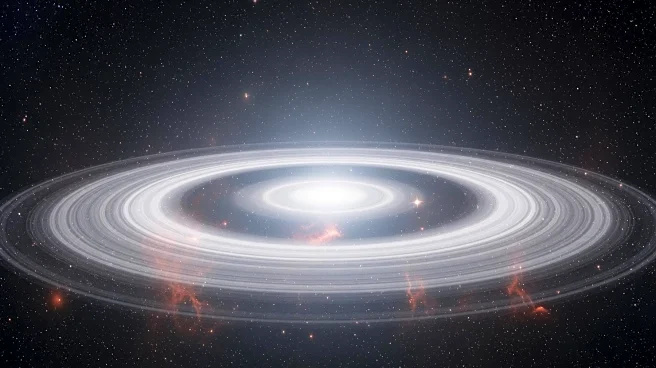
NASA's Hubble Space Telescope has captured images of the largest protoplanetary disk ever observed, surrounding a young star. This disk, known as IRAS 23077+6707, spans nearly 400 billion miles, making it 40 times the size of our solar system. The disk's
turbulent and asymmetric features provide a unique perspective for studying planet formation. The findings, published in The Astrophysical Journal, highlight the disk's complex structure, which includes vertically imposing filament-like features on one side. This discovery challenges existing theories of planetary system development and offers a new laboratory for understanding the environments where planets form.
Why It's Important?
The discovery of such a massive and turbulent protoplanetary disk is significant as it may reshape current theories on how planetary systems develop. The disk's size and structure suggest it could host a vast planetary system, providing ample material for forming multiple gas giants. This finding advances NASA's efforts to explore the universe and understand our place within it. By studying this disk, scientists can gain insights into the processes that shape planet nurseries, potentially leading to a better understanding of how planets, including those in our solar system, form under extreme conditions.
What's Next?
Future observations and studies of IRAS 23077+6707 will likely focus on understanding the dynamic processes shaping the disk. Researchers may explore the interactions between the disk and its surroundings, as well as the potential for planet formation within such a massive environment. These studies could provide further insights into the fundamental processes of planetary system development and help refine models of planet formation.