







What's Happening?
U.S. Senator John Thune has been actively engaging with farmers and ranchers across South Dakota, emphasizing the critical role of agriculture in the state's economy. He has participated in various agricultural forums, including discussions with ranchers in Bison,
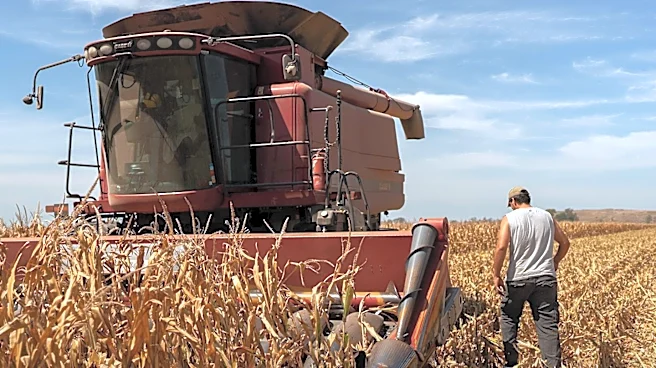
grain elevator operators in Lemmon, and events at the Brown County Fair, Dakotafest, and Sioux Falls. These conversations are informing his legislative efforts in Washington, particularly concerning the farm bill. Thune highlighted that a five-year farm bill, which includes over 100 bipartisan provisions, was considered by the Senate Agriculture Committee. He expressed disappointment that political disagreements prevented its advancement to the Senate floor, but affirmed that work continues to pass the legislation. Key priorities within this farm bill, informed by his discussions with South Dakota producers, include the CRP Flexibility and Improvement Act, which would allow grazing on all Conservation Reserve Program (CRP) acres and increase payment limits. Other provisions aim to enhance transparency in the fertilizer market, strengthen smaller meat processors, and ensure year-round E15 availability, a long-standing priority for South Dakota producers.
Why It's Important?
The efforts by Senator Thune are crucial for the agricultural sector in South Dakota and potentially for national agricultural policy. Agriculture is described as the 'lifeblood' of South Dakota, impacting communities statewide. The proposed farm bill, if passed, would provide significant support to farmers and ranchers facing challenging economic conditions. Provisions like the CRP Flexibility and Improvement Act could offer new revenue streams and land management options for producers, while increased payment limits for CRP acres would provide greater financial stability. Strengthening smaller meat processors could enhance competition and resilience within the food supply chain, benefiting both producers and consumers. The push for year-round E15 availability is significant for corn growers and the biofuels industry, potentially increasing demand for agricultural products. The delay in passing the farm bill, attributed to political divisions, underscores the challenges in enacting comprehensive agricultural legislation, which can leave producers in uncertainty regarding future programs and support. The outcome of these legislative efforts will directly influence the economic viability and sustainability of farming and ranching operations.
What's Next?
Senator Thune and other proponents of the farm bill will continue their efforts to get the legislation across the finish line, despite the current setback in the Senate Agriculture Committee. The bill's advancement will likely require overcoming political hurdles and securing bipartisan support, especially given the upcoming election year dynamics. Discussions and negotiations will persist to address the concerns that prevented its initial passage. Stakeholders, including agricultural organizations and individual farmers and ranchers, will likely maintain pressure on lawmakers to prioritize and pass a comprehensive farm bill. The specific provisions championed by Thune, such as those related to CRP, fertilizer market transparency, and E15, will remain key points of focus in future legislative debates. The ongoing work aims to ensure that the critical priorities of America's producers are addressed in the final legislation.
Beyond the Headlines
The ongoing struggle to pass the farm bill highlights a broader challenge in U.S. politics: the difficulty of enacting comprehensive legislation that balances diverse interests, even in sectors as fundamental as agriculture. The political divisions mentioned by Senator Thune, where 'Democrats chose to put politics ahead of producers,' suggest a deeper partisan gridlock that can impede essential policy updates. This situation can lead to uncertainty for farmers and ranchers, who rely on these programs for planning and financial stability. Furthermore, the emphasis on supporting domestic production and addressing supply constraints, as noted by Thune regarding beef imports, reflects a growing national conversation about food security and the resilience of the U.S. agricultural system. The debate over the farm bill is not just about subsidies and programs; it's about the long-term vision for American agriculture, its environmental impact, and its role in the global food supply. The outcome will shape not only the economic landscape for rural communities but also broader environmental and trade policies.