



What's Happening?
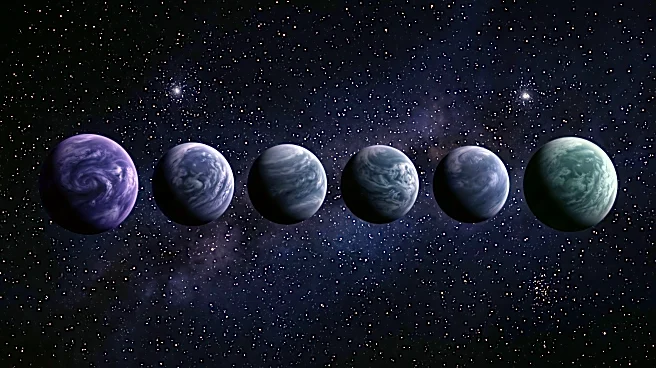
Astronomers have identified a rare planetary system, HD110067, located approximately 100 light-years from Earth, featuring six planets in a precisely coordinated orbital resonance. This discovery began in 2020 with the TESS space telescope detecting initial
transits, followed by further observations suggesting four planets. The European Space Agency’s (ESA) CHEOPS telescope provided crucial data, confirming the first three planets and revealing their resonant orbits. The innermost planet orbits in 9.11 days, the next in 13.67 days, and the third in 20.52 days. This mathematical rhythm allowed scientists to predict the existence of three additional outer planets, which were subsequently confirmed. The system's brightness makes it a prime candidate for studying planetary structure. Each of the six worlds is estimated to have a mass lower than Neptune's and possesses extensive, dense atmospheres, similar to Uranus or Neptune, making them unique compared to our solar system's planets.
Why It's Important?
The discovery of HD110067 is significant because it represents a planetary system that has retained its original orbital resonance, a state believed to be common at the birth of most planetary systems but rarely preserved. Scientists estimate that only about 1% of all planetary systems maintain this primordial configuration, as gravitational influences, giant planet formation, or collisions typically disrupt this delicate balance over billions of years. This 'perfect' system offers a unique opportunity for astronomers to study a planetary system in its initial, undisturbed state, providing invaluable insights into how planets form and evolve. The presence of sub-Neptune-sized planets with dense atmospheres, a class not found in our solar system, also makes HD110067 an excellent target for detailed atmospheric analysis using advanced instruments like the James Webb Space Telescope. Such studies could help determine if these exoplanets are rocky worlds with exceptionally thick atmospheres or possess liquid water oceans beneath their clouds, expanding our understanding of planetary diversity and habitability.
What's Next?
The HD110067 system is slated for further in-depth analysis using the James Webb Space Telescope. Researchers plan to leverage the telescope's capabilities to study the extensive, dense atmospheres of these six planets. The primary goal is to determine their composition and structure, specifically investigating whether these worlds are rocky with thick atmospheres, akin to Earth or Venus but on a larger scale, or if they harbor liquid water oceans beneath their gaseous envelopes. This detailed atmospheric characterization will provide critical data for exoplanetology, potentially revealing new insights into the conditions necessary for planetary habitability and the diverse pathways of planetary evolution. Future observations will aim to refine orbital parameters, mass estimates, and atmospheric profiles, contributing to a more complete understanding of this exceptionally preserved planetary system.
Beyond the Headlines
The rarity of a planetary system maintaining its initial orbital resonance, as seen in HD110067, suggests that the chaotic processes of planetary evolution are far more prevalent than stable, long-term configurations. This discovery challenges existing models of planetary formation and migration, highlighting the need for more nuanced theories that account for such 'perfect' systems. The existence of sub-Neptune planets, a type absent in our solar system, underscores the vast diversity of exoplanets and prompts questions about why our solar system lacks such common planetary types. Understanding the atmospheric conditions and potential for liquid water on these distant worlds could redefine our search for life beyond Earth, shifting focus to planetary types previously considered less conventional. This system serves as a natural laboratory, offering a window into the early universe and the fundamental principles governing the architecture of planetary systems.